
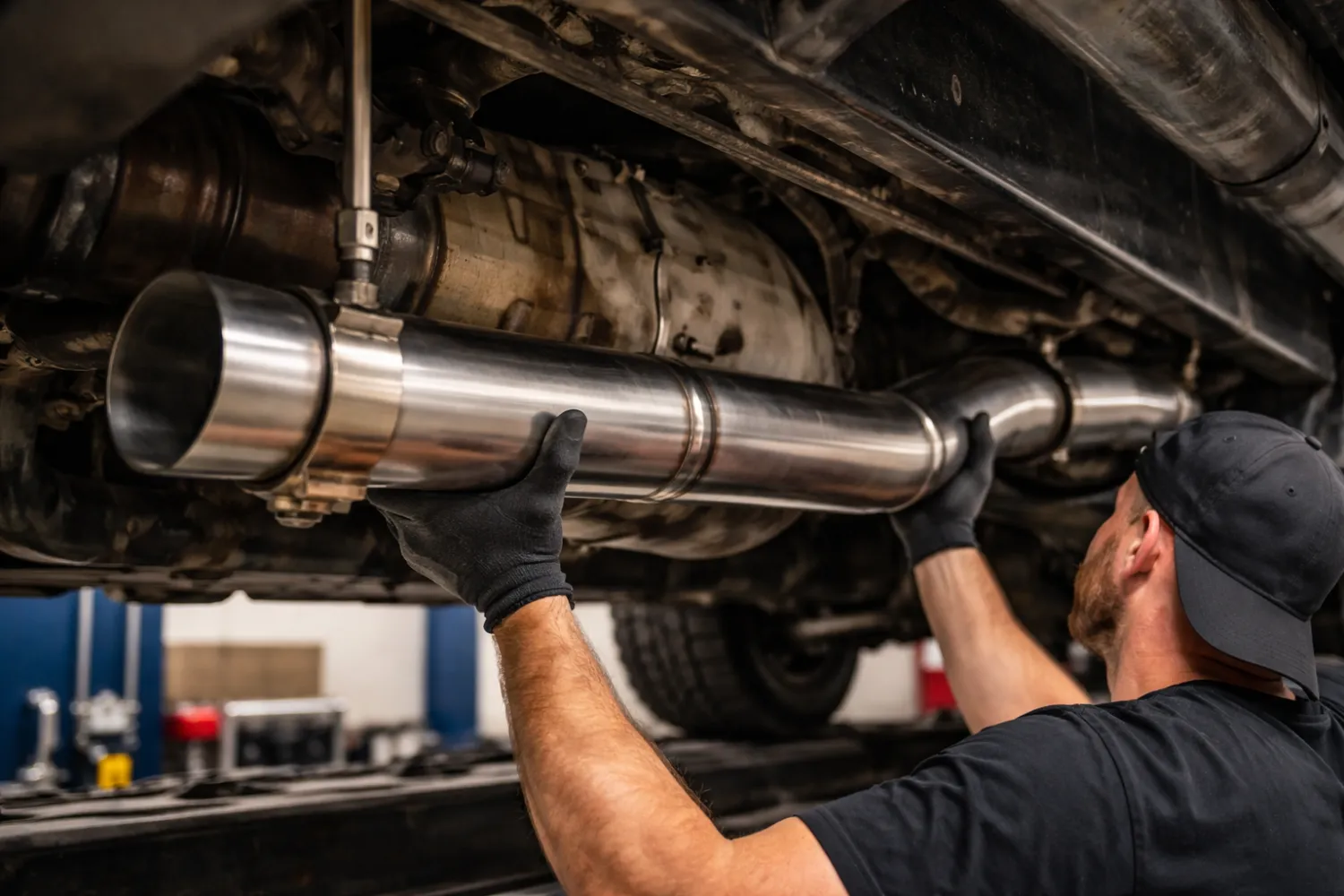
The 2016 Duramax delete pipe sits at the center of one of the most meaningful performance upgrades you can make to an LML Duramax built for off-road use. Not because it’s flashy. Not because it’s loud. But because it fundamentally changes how the engine breathes, manages heat, and responds under load.
If you’ve driven a stock 2016 Duramax hard towing, racing, or pushing it in private off-road environments you already know the feeling. The truck has power on paper, but it feels held back. Throttle response lags. Exhaust temperatures spike quickly. Regeneration cycles interrupt power delivery at the worst possible moments.
That behavior is not accidental. It’s the result of an exhaust system designed primarily around emissions compliance rather than airflow efficiency. At Explosive Diesels, performance is about removing bottlenecks intelligently. A delete pipe isn’t a shortcut. It’s a structural change that restores exhaust flow and thermal balance when emissions hardware is no longer required for off-road operation.
Why the 2016 Duramax Responds So Well to a Delete Pipe
The 2016 LML Duramax (6.6L) is a robust platform. Strong internals. Proven fuel delivery. A turbocharger capable of supporting far more airflow than the factory system allows.
The issue starts after the turbo.
From the factory, exhaust gases must pass through a Diesel Oxidation Catalyst (DOC), a Diesel Particulate Filter (DPF), and then a Selective Catalytic Reduction (SCR) system that injects diesel exhaust fluid (DEF). Each stage adds restriction and traps heat.
According to the U.S. Environmental Protection Agency, DPF systems are specifically designed to capture soot and periodically burn it off through regeneration cycles, a process that increases exhaust temperature and fuel consumption under load (EPA – Diesel Particulate Filters, United States Environmental Protection Agency).
That heat doesn’t disappear. It travels upstream.
A 2016 Duramax delete pipe removes those choke points and allows exhaust gases to exit cleanly and efficiently.
Understanding the Factory Emissions System on the 2016 Duramax
To understand why deleting works, you need to understand what’s being removed.
Factory Exhaust Components
- Diesel Oxidation Catalyst (DOC) – oxidizes unburned hydrocarbons
- Diesel Particulate Filter (DPF) – traps soot particles
- Selective Catalytic Reduction (SCR) – injects DEF to reduce NOx emissions
- Multiple exhaust gas temperature and pressure sensors
Each component serves an emissions function. None are optimized for performance.
Wikipedia’s overview of the Diesel Particulate Filter explains how soot accumulation increases exhaust backpressure over time, requiring active regeneration to burn off particulates and restore flow (Diesel Particulate Filter, Wikipedia).
That regeneration process is one of the biggest performance disruptors in stock LML trucks.
What a 2016 Duramax Delete Pipe Actually Is
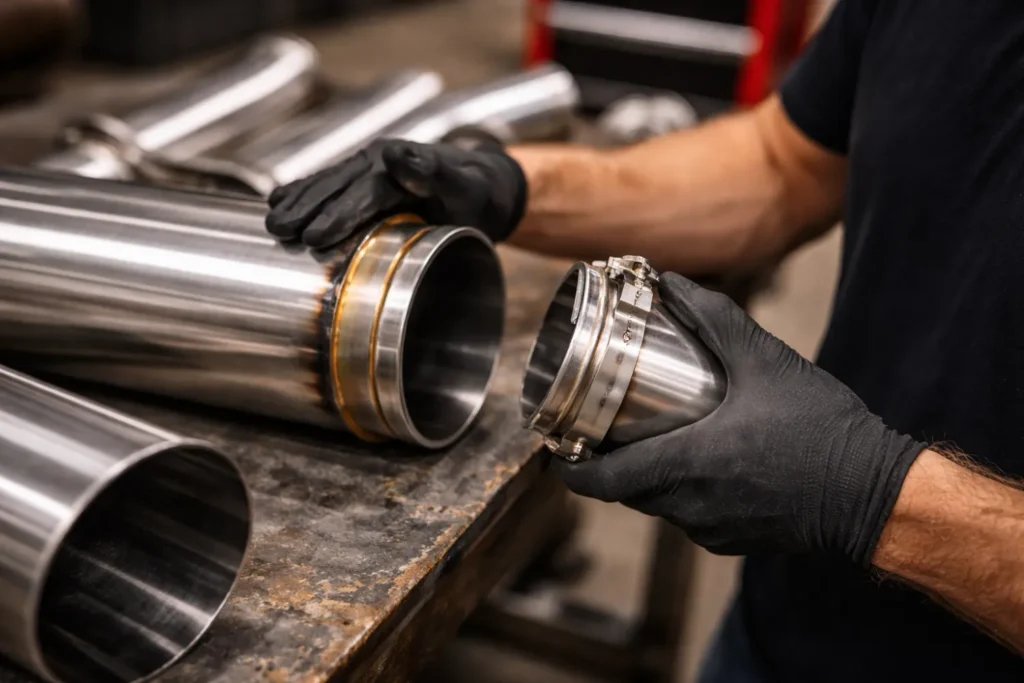
A 2016 Duramax delete pipe replaces the restrictive emissions sections of the exhaust with a straight-through, mandrel-bent pipe designed for maximum flow.
No filtration.
No chemical reactions.
No forced regen cycles.
Just controlled exhaust evacuation.
Common Delete Pipe Configurations
- DPF-only delete pipe
- Full turbo-back delete system
- Race pipe setups for competition trucks
Most off-road builds choose a full turbo-back configuration because it eliminates all major restriction points in one step.
Performance Gains You Can Actually Feel
This is where theory meets real-world results.
With proper tuning, a 2016 Duramax delete pipe delivers:
- 40–80 horsepower gains
- Stronger mid-range torque
- Faster turbo spool
- Smoother power delivery
But peak numbers don’t tell the full story.
Throttle response sharpens. Acceleration feels cleaner. The engine pulls without hesitation under sustained load. That difference becomes obvious the first time you tow or climb under heavy throttle in an off-road environment.
Exhaust Gas Temperatures: Why They Drop After Deleting
High EGTs are one of the leading contributors to long-term diesel engine wear. The factory exhaust traps heat downstream, forcing the turbocharger and exhaust manifold to operate in a hotter environment.
Once a 2016 Duramax delete pipe is installed, exhaust heat exits faster.
Why Lower EGTs Matter
- Reduced turbocharger stress
- Lower risk of cracked manifolds
- Improved piston and valve durability
- Safer sustained high-load operation
For trucks that work hard off-road, this change alone often improves long-term reliability.
Sound Characteristics: More Mechanical, Less Muffled
Deleting the exhaust changes how the truck sounds, but the result doesn’t have to be chaotic.
What Most Owners Notice
- Deeper exhaust tone
- Clearer turbo whistle
- More pronounced throttle response acoustics
- Louder cold starts
Sound quality depends on pipe design and whether a muffler is retained.
| Setup | Sound Profile | Best Use |
| Straight pipe | Aggressive | Race-only builds |
| Performance muffler | Controlled | Off-road/tow rigs |
Flow does not require excessive volume. Quality systems prove that daily.
Materials and Build Quality: Where Problems Start or End
Not all delete pipes are created equal.
Common Materials
- Aluminized steel – lower cost, shorter lifespan
- T304 stainless steel – corrosion-resistant, long-term durability
Quality Indicators
- Mandrel-bent tubing
- Precision welds
- Proper flange alignment
- Correct hanger placement
Cheap kits often crack, leak, or vibrate under load. Those issues negate performance gains quickly.
Choosing the Right 2016 Duramax Delete Pipe
Fitment is not universal.
Consider:
- Cab length
- Bed length
- Existing exhaust components
- Power goals
Pipe Diameter Comparison
| Diameter | Recommended Use |
| 4-inch | Stock turbo, moderate tuning |
| 5-inch | High-horsepower builds |
Oversizing can reduce exhaust velocity on lower-power setups, so choose intentionally.
Supporting Mods That Make a Delete Pipe Work Properly
A 2016 Duramax delete pipe must be paired with proper supporting upgrades.
Required
- Custom tuning
- Exhaust temperature monitoring
- Intake airflow upgrades
Strongly Recommended
- Transmission tuning
- Lift pump for fuel stability
- Turbo upgrades for higher power targets
Skipping tuning is not an option. The truck will not operate correctly without it.
Installation Overview: What the Process Looks Like
Installation is straightforward but not rushed.
Typical Install Notes
- 4–6 hours for experienced installers
- Lift access simplifies removal
- Rusted bolts can slow the process
Common Mistakes
- Reusing old gaskets
- Improper clamp alignment
- Ignoring hanger clearance
- Forgetting sensor provisions
Attention to detail prevents leaks and rattles later.
Reliability and Maintenance After Deleting
Once installed and tuned correctly, reliability improves.
Long-Term Benefits
- No regeneration cycles
- Reduced soot contamination
- Cleaner oil
- Lower thermal stress
Many off-road owners report smoother operation and fewer heat-related issues over time.
Mistakes That Kill the Benefits

Avoid these:
- Running a delete pipe without tuning
- Buying low-quality kits
- Ignoring transmission limits
- Over-fueling without airflow support
- Skipping gauges
A delete pipe magnifies system weaknesses. Build accordingly.
Legal and Off-Road Use Disclaimer
A 2016 Duramax delete pipe is intended for off-road, race, or competition use only on vehicles not operated on public roads.
Always understand and comply with local, state, and federal regulations.
Explosive Diesels promotes informed, responsible performance modifications.
Who Benefits Most From a 2016 Duramax Delete Pipe
This upgrade fits:
- Off-road racers
- Sled pullers
- Farm and ranch trucks
- Private-property towing rigs
- Purpose-built performance builds
It does not fit daily street-driven vehicles.
Final Thoughts: Performance Comes From Flow
The 2016 Duramax delete pipe is not a trend piece. It’s a structural upgrade that restores airflow, reduces heat, and unlocks the Duramax’s real capability in off-road environments.
Built correctly, it delivers:
- Cleaner power
- Lower temperatures
- Better drivability
- Improved longevity
At Explosive Diesels, we believe performance should be intentional. Choose quality components. Support them properly. Tune responsibly. Monitor your engine.That’s how serious Duramax builds last.
FAQs
A 2016 Duramax delete pipe replaces restrictive factory emissions components with a straight-through exhaust designed for off-road or competition use.
Yes, when paired with proper tuning, a delete pipe can add 40–80 horsepower by improving exhaust flow and reducing backpressure.
Yes, custom tuning is mandatory to prevent error codes, limp mode, and drivability issues after deleting emissions components.
Yes, EGTs typically drop noticeably because exhaust heat exits the system more efficiently without DPF-related restrictions.
Sound levels vary based on pipe design and muffler choice, ranging from controlled and deep to aggressive and race-oriented.
Yes, for off-road or private-property use, towing often improves due to lower EGTs and better throttle response.
A 4-inch pipe suits stock or moderately tuned trucks, while a 5-inch pipe works best for high-horsepower builds.
Fuel efficiency can improve slightly in off-road use because the engine no longer performs regeneration cycles.
When installed and tuned correctly, deleting can improve reliability by reducing heat, soot buildup, and exhaust restriction.
No, delete pipes are intended only for off-road, race, or competition vehicles and should not be used on public roads.