

The 3.0 Powerstroke straight pipe conversation always heats up fast once diesel owners start talking about performance. Sound comes up first. Then turbo response. Then the inevitable debate about whether it’s worth it. I’ve seen this play out countless times, and the truth sits somewhere between hype and hesitation.
If you’re building an off-road-focused truck and want fewer restrictions, quicker response, and a sound that actually reflects what the engine is doing, a 3.0 Powerstroke straight pipe isn’t just noise for the sake of noise. It’s a functional decision. One that deserves a clear, honest breakdown.
That’s exactly what this is.
Understanding the 3.0 Powerstroke Platform
Ford’s 3.0L Powerstroke was designed to balance efficiency, drivability, and emissions compliance. It’s a compact V6 diesel that relies heavily on exhaust management to keep things smooth and quiet. From the factory, that means multiple exhaust components whose main job is to reduce sound and control exhaust flow.
Those components work well for daily driving. Off-road, they can feel restrictive.
Diesel engines depend on efficient exhaust evacuation, especially turbocharged ones. When exhaust gases struggle to exit the system, turbo efficiency suffers and heat builds faster. That’s not theory. It’s basic engine behavior tied directly to exhaust design.
The fundamentals of how exhaust systems function and how restrictions impact performance are well documented in engine engineering. A clear technical overview can be found in Wikipedia’s breakdown of exhaust systems, which explains how exhaust routing, backpressure, and flow influence engine operation.
Understanding this context makes straight piping easier to evaluate logically instead of emotionally.
What a Straight Pipe Means on a 3.0 Powerstroke
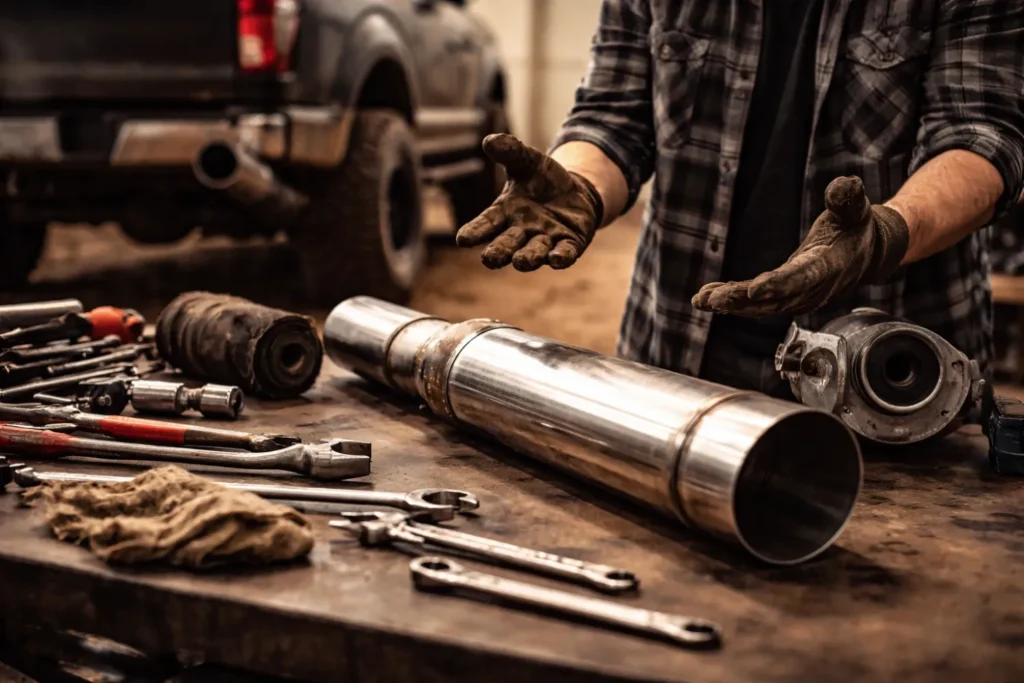
A straight pipe exhaust removes mufflers and resonators entirely. On a 3.0 Powerstroke straight pipe, exhaust gases move from the turbo outlet to the tailpipe with minimal resistance.
There’s no sound tuning. No filtering. Just open flow.
This setup differs from:
- Muffler deletes, which still retain some restriction
- Performance exhaust systems designed to balance sound and compliance
Straight piping is the simplest form of exhaust optimization. Fewer components. Less weight. Fewer failure points.
It’s not subtle. And it’s not meant to be.
Why Diesel Owners Straight Pipe Modern Engines
People don’t straight pipe modern diesels because they’re bored. They do it because exhaust flow matters, especially when pushing an engine harder than factory conditions.
A 3.0 Powerstroke straight pipe appeals to owners who want:
- Reduced backpressure
- Faster turbo spool
- More immediate throttle response
- Improved efficiency under sustained load
Diesels thrive on breathing freely. Straight pipes remove bottlenecks that were never designed for aggressive or prolonged off-road use.
Performance Gains You Can Actually Feel

Let’s be realistic. A straight pipe alone won’t double your horsepower. What it does is remove resistance that holds the engine back.
With a 3.0 Powerstroke straight pipe, most drivers notice:
- Quicker turbo response
- Smoother acceleration under load
- Less hesitation at throttle tip-in
- Reduced exhaust heat buildup during hard use
Here’s a clear comparison.
| Feature | Stock Exhaust | Straight Pipe |
| Exhaust restriction | High | Minimal |
| Turbo efficiency | Limited | Improved |
| Weight | Heavier | Lighter |
| Throttle response | Softer | Sharper |
These changes add up. Especially off-road.
Sound: Honest, Mechanical, and Unfiltered
Sound is where straight pipes divide opinions. A 3.0 Powerstroke straight pipe delivers a clean diesel tone without rasp or artificial tuning.
You’ll notice:
- Strong cold starts
- A deeper idle note
- Audible turbo whistle under load
- Aggressive acceleration sound
Turbochargers naturally dampen exhaust noise, which keeps things from becoming chaotic. Still, straight pipes are loud. There’s no pretending otherwise.
Pros
- Authentic diesel sound
- Better engine feedback
- Turbo noise becomes audible
Cons
- Higher cabin volume
- Possible drone at steady speeds
- Not ideal for daily commuting
Sound preference is personal. Purpose should guide the decision.
Weight Reduction and Simplicity Benefits
Factory exhaust systems are heavy. Mufflers, resonators, and complex routing add unnecessary mass.
Straight piping reduces weight in a critical area of the truck. That helps:
- Suspension response
- Vehicle balance
- Off-road traction
It also removes components that can crack, clog, or fail over time. Fewer parts mean fewer problems when you’re miles from pavement.
Off-Road Use Cases Where Straight Pipes Shine
A 3.0 Powerstroke straight pipe makes the most sense on:
- Dedicated off-road trucks
- Trail rigs
- Overland builds
- Performance-focused diesel projects
It’s less suitable for noise-restricted environments or trucks that spend most of their time idling in traffic.
This mod rewards intentional builds. Not compromises.
Supporting Mods That Make It Work Better
Straight pipes deliver the best results when paired with the right supporting upgrades.
Recommended pairings include:
- ECU tuning calibrated for reduced backpressure
- High-flow downpipes
- Intake improvements
- Exhaust gas temperature monitoring
| Supporting Mod | Benefit |
| ECU tune | Optimizes fueling and boost |
| Downpipe | Improves turbine efficiency |
| Intake | Balances airflow |
| EGT gauge | Protects engine health |
The straight pipe sets the stage. The rest of the build completes the performance picture.
Installation Overview
Installing a 3.0 Powerstroke straight pipe can be bolt-on or custom-fabricated depending on the system.
General steps include:
- Removing factory exhaust sections
- Fitting straight pipe segments
- Ensuring proper clearance
- Securing with quality hangers and clamps
DIY installs are possible, but professional fabrication ensures correct alignment and long-term durability.
Heat Management and EGT Considerations
Reduced backpressure allows exhaust gases to exit faster. That can help stabilize exhaust gas temperatures during hard use.
This matters when:
- Climbing steep grades
- Running sustained throttle
- Operating in high ambient temperatures
Straight piping doesn’t eliminate the need for monitoring. It simply improves efficiency.
Material Choices Matter
Not all straight pipes are created equal.
Common materials:
- Aluminized steel: Affordable, shorter lifespan
- T304 stainless steel: Corrosion-resistant, long-term durability
For off-road environments, stainless steel is usually worth the extra cost. Mud, water, and debris don’t forgive cheap materials.
Legal and Emissions Reality (Off-Road Context)
This part matters.
A 3.0 Powerstroke straight pipe is typically considered an off-road-only modification. Exhaust systems are closely tied to emissions compliance, and removing factory components can affect a vehicle’s legal status on public roads.
The U.S. Environmental Protection Agency outlines how vehicle emissions systems are regulated and why certain exhaust components are required for on-road vehicles. Their official guidance helps explain why straight pipe setups are generally limited to off-road or competition use:
https://www.epa.gov/vehicle-and-engine-certification
Understanding these rules helps owners make informed decisions and avoid unnecessary issues.
Common Myths About Straight Pipes
Myth: Straight pipes kill low-end torque
Reality: Reduced backpressure often improves efficiency when tuned properly
Myth: Drone is unavoidable
Reality: Gearing, driving style, and setup matter
Myth: Turbos are damaged
Reality: Lower backpressure typically reduces turbo stress
Experience beats internet noise every time.
Is a 3.0 Powerstroke Straight Pipe Right for Your Build?
Ask yourself:
- Is this truck primarily off-road?
- Do I value response over refinement?
- Am I pairing this with proper tuning?
- Am I comfortable with increased sound?
If the answer is yes, a 3.0 Powerstroke straight pipe can be one of the most rewarding exhaust mods available.
If not, a performance exhaust may be the better fit.
Final Thoughts: Purpose-Built Performance
Straight piping isn’t about attention. It’s about intent.
A 3.0 Powerstroke straight pipe removes restrictions and lets the engine behave the way diesel engines naturally want to. Free-flowing. Responsive. Mechanical.
At Explosive Diesels, performance is about making informed choices and building with purpose. When done right, straight piping delivers exactly what off-road diesel enthusiasts are after.
Raw sound. Real response. No apologies.
FAQs
A 3.0 Powerstroke straight pipe removes mufflers and resonators to create a free-flowing exhaust system that maximizes airflow and sound for off-road use.
Yes, it reduces exhaust backpressure, which can improve turbo response and overall efficiency, especially during heavy throttle or off-road driving.
It produces a noticeably louder and more aggressive diesel tone, especially during cold starts and acceleration, with volume depending on driving style and setup.
Drone can occur at steady cruising speeds, but its severity depends on gearing, load, and how often the engine stays in a narrow RPM range.
In most cases, no; straight pipes are generally intended for off-road or competition use due to emissions and noise regulations.
No, reduced backpressure often helps the turbo operate more efficiently when paired with proper tuning.
A tune isn’t required, but it helps optimize fueling and boost to fully take advantage of the improved exhaust flow.
T304 stainless steel offers the best durability and corrosion resistance, making it ideal for off-road environments.
No, lower exhaust backpressure typically reduces stress on the turbo rather than increasing it.
It’s best suited for off-road builds and owners who prioritize performance, responsiveness, and raw diesel sound over quiet daily driving.