
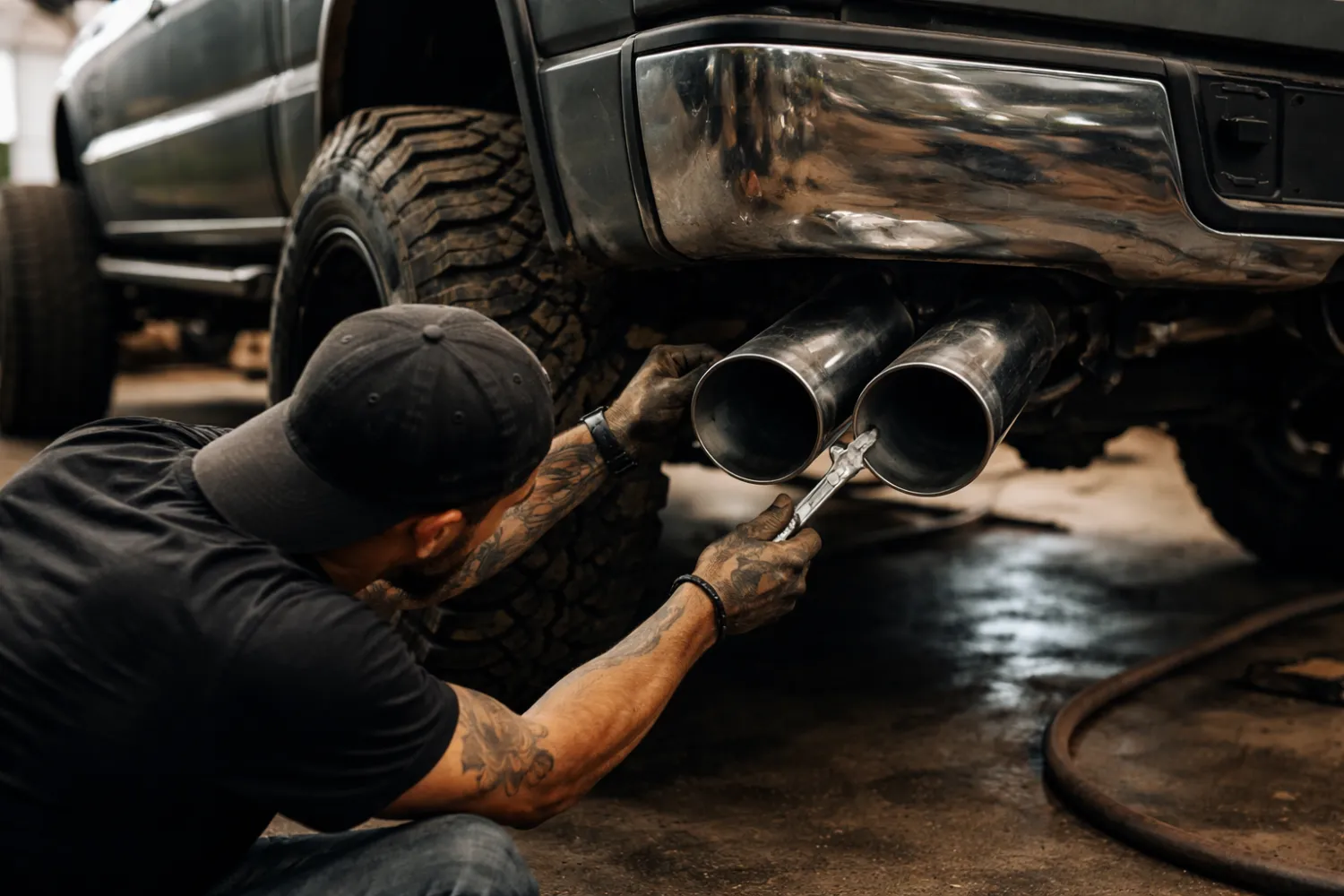
The phrase dual exhaust diesel still turns heads. It always has. Two pipes. Symmetry. Aggression. A truck that looks serious even when it’s sitting still. For many diesel owners, dual exhaust feels like one of those mods that instantly elevates a build from ordinary to intentional.
I get it. I’ve been there.
But diesel engines don’t follow the same exhaust rules as gas engines. Torque delivery is different. Turbochargers change the math. And chasing a look without understanding airflow can quietly take performance off the table instead of adding it.
This article breaks down the real-world performance truth behind dual exhaust diesel systems, how they affect sound and drivability, and most importantly when they actually make sense for an off-road diesel build.
No fluff. No recycled forum myths. Just diesel logic that holds up under load.
What “Dual Exhaust Diesel” Really Means Today
Before we talk performance, we need clarity.
When most people say dual exhaust diesel, they’re usually describing one of three setups:
- A true dual exhaust, where exhaust flow splits early and runs through two separate pipes
- A single exhaust that splits after the muffler
- A single turbo system with dual rear exits, purely for appearance
These are not interchangeable designs.
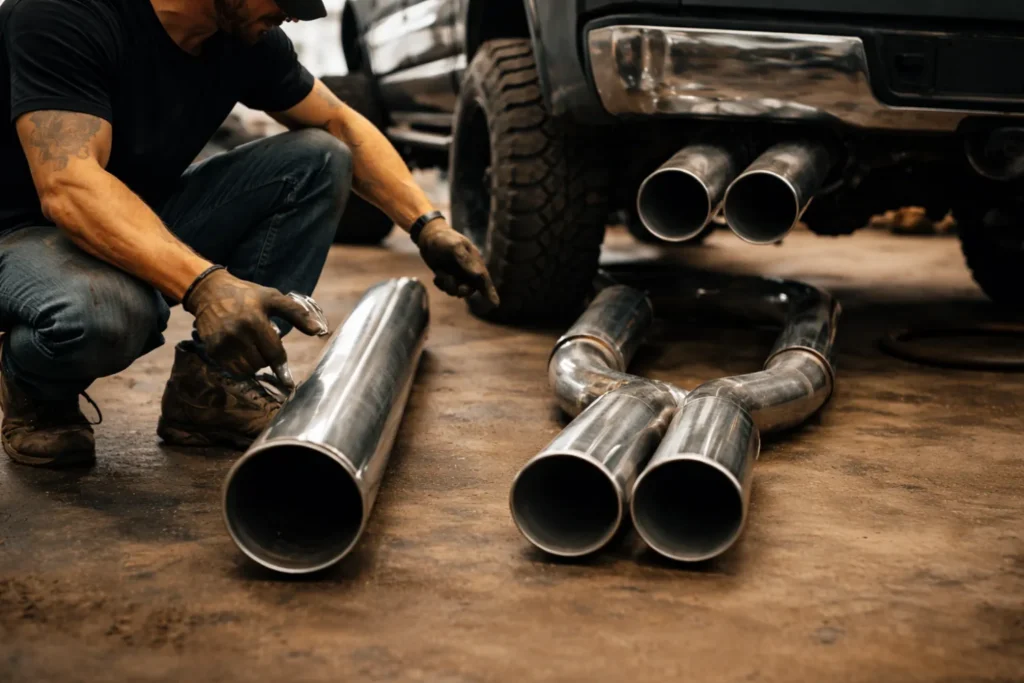
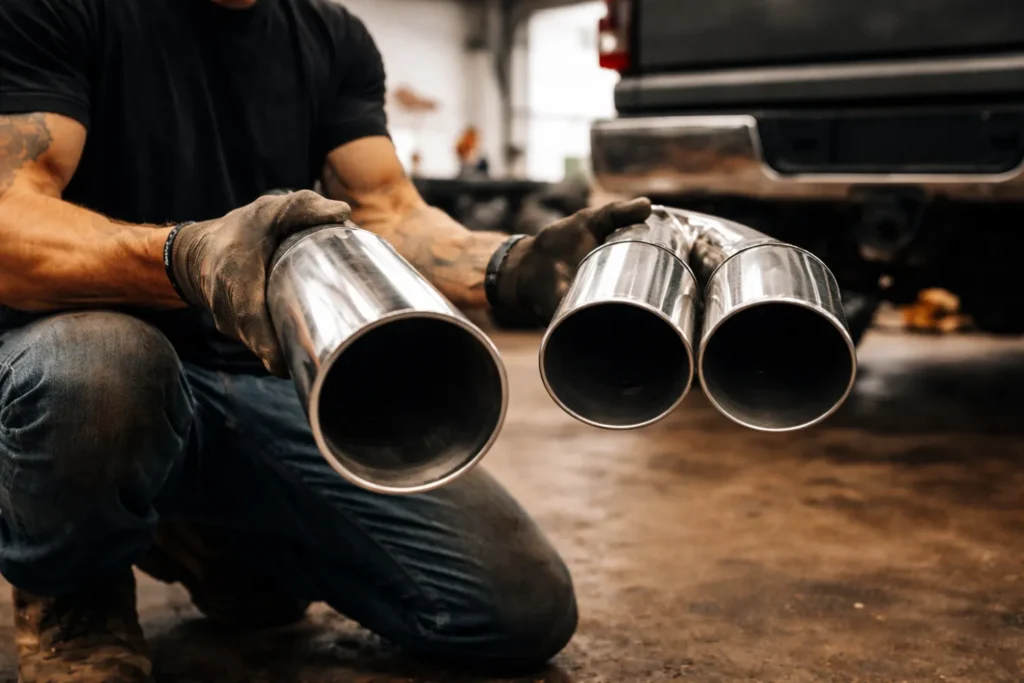
A true dual system changes exhaust dynamics from the downpipe back. A split-rear setup preserves exhaust velocity almost entirely. Most diesel trucks you see with dual tips fall into the second category and that distinction matters.
Diesel exhaust systems are not about scavenging. They’re about energy delivery. Lose focus in the flow and you lose usable torque.
How Exhaust Flow Works on Turbo Diesels
Turbocharged diesel engines rely on exhaust energy more than most people realize. Exhaust gases don’t just exit the engine they drive the turbine that creates boost. That means velocity matters just as much as volume.
Any change in exhaust routing, pipe diameter, or split location affects turbine speed, spool characteristics, and throttle response. This is why many diesel performance gains come from improving the downpipe or reducing turbulence rather than simply increasing pipe size.
The fundamentals of how turbochargers convert exhaust energy into boost are well documented and explain why focused, efficient exhaust flow is critical on diesel engines especially when evaluating a dual exhaust diesel setup.
That reality shapes everything that follows.
Single vs Dual Exhaust on a Diesel Truck
Here’s the core difference in plain terms:
- Single exhaust systems maintain exhaust velocity
- Dual exhaust systems increase volume but can reduce velocity
Gas engines can benefit from exhaust scavenging. Turbo diesels don’t need it. They need consistent, directed energy hitting the turbine.
Strengths of a Single Exhaust
- Faster turbo response
- Simpler routing
- Lower cost
- Less weight
- Better off-road clearance
Strengths of a Dual Exhaust Diesel Setup
- Aggressive sound
- Visual balance
- Reduced restriction if designed correctly
- Show-truck appeal
Neither option is wrong. But they serve different goals.
Does Dual Exhaust Diesel Actually Add Power?
This is where expectations need a reset.
On most single-turbo diesel trucks, dual exhaust diesel systems do not add measurable horsepower compared to a properly sized high-flow single exhaust.
That’s not opinion. That’s airflow physics.
The main restrictions on a diesel are:
- The turbocharger
- The downpipe
- Emissions equipment (if still installed)
Once those are addressed, splitting exhaust flow rarely unlocks additional power.
Situations Where Dual Exhaust Can Help
- High-horsepower competition builds
- Compound turbo setups
- Custom-fabricated true dual systems
- Trucks pushing airflow limits
Situations Where It Usually Doesn’t
- Stock or lightly modified trucks
- Daily-driven off-road rigs
- Single turbo street builds
Comparison at a glance:
| Setup | Power Potential | Turbo Response | Cost | Off-Road Practicality |
| 4″ Single Exhaust | Strong | Excellent | $ | High |
| 5″ Single Exhaust | Moderate | Very Good | $$ | High |
| Dual Exhaust Diesel | Minimal (most builds) | Variable | $$$ | Medium |
If raw performance is your priority, single exhaust almost always wins.
Sound: The Real Reason Most People Go Dual
Let’s be honest.
Most diesel owners choose dual exhaust diesel systems for sound and appearance—not power.
And that’s okay.
Dual exhaust tends to widen the exhaust note. You’ll often hear:
- A deeper idle tone
- Sharper bark under throttle
- More presence without necessarily more volume
But design matters.
Sound Is Influenced By:
- Pipe diameter
- Muffler choice
- Exit location
- Cab insulation
A poorly designed dual setup can introduce drone, especially at highway speeds. A split-after-muffler configuration usually avoids this while still delivering the dual-pipe look.
If sound is the goal, layout matters more than pipe count.
Turbo Diesels and Dual Exhaust Compatibility
Turbo diesels thrive on focused exhaust energy. Every bend, split, and expansion affects turbine efficiency.
That’s why most performance builders prioritize:
- Large single downpipes
- Smooth transitions
- Minimal turbulence
A true dual exhaust diesel system can work but only when:
- Pipe diameter is reduced appropriately
- Flow remains balanced
- The split occurs after the turbocharger
Oversized duals slow exhaust velocity. Slower velocity equals slower spool. And slower spool is immediately noticeable off-road, where throttle response matters more than peak horsepower.
Off-Road Use Cases Where Dual Exhaust Makes Sense
There are legitimate scenarios where dual exhaust works.
Good Candidates
- High-horsepower competition trucks
- Show builds with custom fabrication
- Compound turbo setups
- Trucks with unique rear routing needs
Poor Candidates
- Rock crawlers needing maximum clearance
- Overland rigs focused on efficiency
- Daily drivers
- Budget-focused builds
Off-road trucks need predictability. That’s where single exhaust systems shine.
Diesel Platforms and Dual Exhaust Feasibility
Not all diesel engines respond the same way.
| Platform | Dual Exhaust Feasibility | Notes |
| 5.9 Cummins | Moderate | Responds best with correct sizing |
| 6.7 Cummins | Moderate | Downpipe matters more than tailpipes |
| LBZ / LMM Duramax | Fair | Sound benefit > power |
| LML / L5P Duramax | Limited | Turbo and tuning dominate gains |
| 6.7 Power Stroke | Fair | Routing and weight challenges |
| EcoDiesel | Poor | Velocity loss hurts performance |
Smaller displacement diesels are generally worse candidates for dual exhaust.
Pipe Sizing: Where Most Dual Builds Go Wrong
This is the biggest mistake I see.
Bigger is not better especially on diesel.
Oversized dual exhaust setups reduce exhaust gas speed, hurting turbo efficiency and usable torque.
Smart Sizing Guidelines
- Single turbo trucks: 4″ or 5″ single exhaust
- Dual setups: Two smaller pipes, not two oversized ones
- Focus on smooth transitions over raw diameter
If dual exhaust is mainly for looks, keep the split late and the pipes reasonable.
Installation Reality: Rarely Bolt-On
Most dual exhaust diesel systems require custom fabrication.
Expect:
- Higher labor costs
- Clearance challenges
- Fuel tank interference
- Suspension travel considerations
Bolt-on kits are rare because diesel frames weren’t designed for symmetrical exhaust routing.
Plan accordingly.
Weight, Cost, and Long-Term Trade-Offs
Dual exhaust adds:
- More piping
- More hangers
- More weight
That matters off-road.
Extra weight impacts:
- Fuel economy
- Rear axle load
- Heat management near suspension components
Cost adds up fast. In most cases, a high-quality single exhaust delivers better performance per dollar.
Dual Exhaust vs High-Flow Single Exhaust
This is the decision point.
If your priority is:
- Performance
- Reliability
- Simplicity
A high-flow single exhaust is the smarter move.
If your priority is:
- Visual impact
- Unique sound
- Show presence
A dual exhaust diesel setup can absolutely make sense.
Just don’t confuse style with performance.
Supporting Mods That Matter More Than Exhaust
If you’re chasing real gains, focus here first:
- Proper tuning
- Turbo upgrades
- Intake efficiency
- Downpipe improvements
- Intercooler upgrades
Exhaust supports performance. It rarely creates it.
Legal and Practical Considerations
Diesel exhaust systems also play a role in emissions behavior, noise levels, and thermal management. Even off-road-focused builds benefit from understanding how exhaust design influences particulate matter, exhaust temperature, and nitrogen oxide formation.
The U.S. Environmental Protection Agency explains how diesel exhaust systems affect emissions output and why exhaust routing and flow characteristics matter even when a vehicle is used primarily off-road. This context helps builders make informed decisions when choosing or fabricating dual exhaust diesel configurations.
Build smart. Build informed.
Is Dual Exhaust Diesel Right for You?
Ask yourself:
- Am I building for function or form?
- Do I prioritize throttle response?
- Does this truck see real off-road use?
There’s no wrong answer only mismatched expectations.
Final Thoughts: Statement or Strategy?
A dual exhaust diesel setup is a statement. Sometimes, that’s exactly what a build needs.
But if your truck is meant to climb, pull, crawl, or run hard off-road, airflow efficiency matters more than symmetry.
Build with intent.
Build with understanding.
And always prioritize performance over hype.
That’s how Explosive Diesels does it.
FAQs
In most single-turbo diesel trucks, a dual exhaust does not add measurable horsepower compared to a properly sized single exhaust.
Most choose dual exhaust for sound, appearance, and visual balance rather than performance gains.
A split-rear setup preserves exhaust velocity better, while true duals require precise sizing to avoid hurting turbo response.
Yes, oversized or poorly designed dual exhaust systems can reduce exhaust velocity and slow turbo spool.
Larger displacement engines like the 5.9L and 6.7L Cummins respond better than smaller diesels, but gains are still limited.
Not usually, since single exhaust systems offer better clearance, durability, and throttle control off-road.
It typically changes tone more than volume, producing a wider and sharper exhaust note.
For performance and drivability, a high-flow 5-inch single exhaust usually outperforms dual exhaust setups.
Most require custom fabrication due to frame, suspension, and fuel tank routing challenges.
Dual exhaust makes the most sense for show trucks, high-horsepower builds, or owners prioritizing style over raw performance.