
If you own an EcoDiesel and care about performance, longevity, and real-world drivability, you’ve already crossed paths with one unavoidable topic: EGR EcoDiesel systems. It comes up in forums. It shows up in check engine lights. And sooner or later, it becomes part of every serious ownership conversation. Some owners ignore it. Others chase repairs. A growing number start asking tougher questions about airflow, heat, and reliability especially once the truck leaves pavement behind.
This guide isn’t here to scare you or sell hype. It’s here to explain what the EGR system does on the EcoDiesel, why it causes so many headaches, and how off-road owners should think about it if they want their engine to last and perform the way it should. I’ve seen too many good EcoDiesel platforms held back by one emissions component that never cared about longevity in the first place. Let’s talk about it.
What the EGR System Does on the EcoDiesel
At its core, the EGR system Exhaust Gas Recirculation reroutes a portion of spent exhaust gas back into the intake stream. The concept itself isn’t new. According to Wikipedia’s technical breakdown of Exhaust Gas Recirculation, EGR systems are primarily used to reduce nitrogen oxide (NOx) emissions by lowering peak combustion temperatures inside the engine.
On paper, that works.
On a modern EcoDiesel, however, the system is far more aggressive than older diesel setups. The EGR EcoDiesel configuration uses high flow rates, advanced cooling, and constant ECU management to meet emissions targets under a wide range of operating conditions.
Key EGR components on the EcoDiesel include:
- EGR valve
- EGR cooler
- Control solenoids and sensors
- ECU logic coordinating EGR, DPF, and DEF
This isn’t a bolt-on accessory. It’s deeply integrated into how the engine breathes and burns fuel.
And that integration is exactly why failures cascade.
Why the EcoDiesel EGR Design Is So Demanding
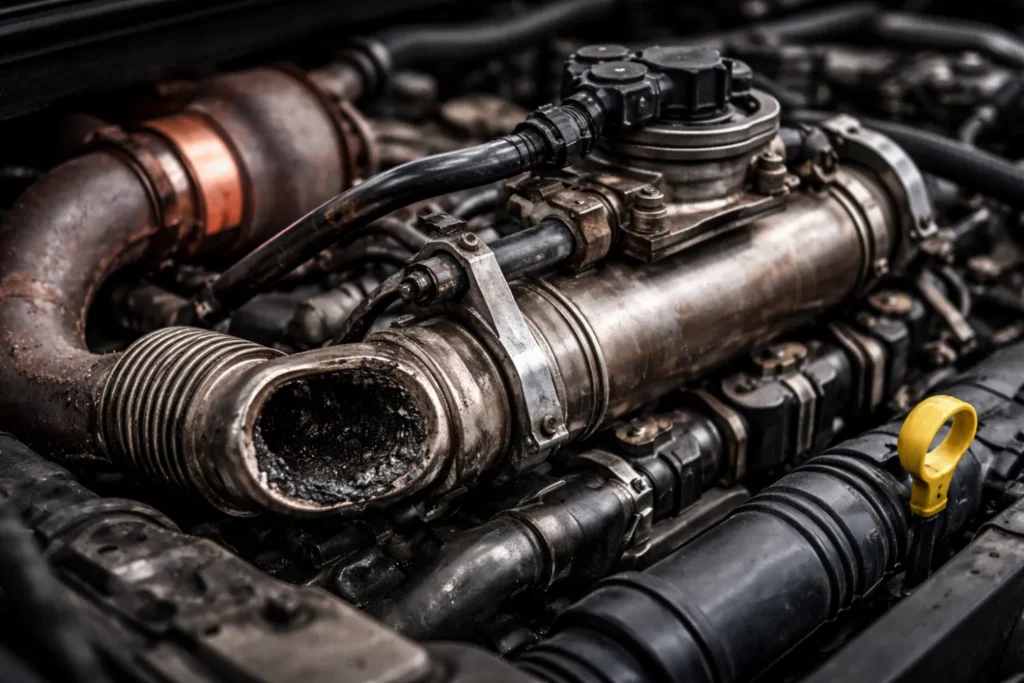
EcoDiesel engines rely heavily on EGR to meet modern emissions standards. That means more exhaust gas is recirculated more often, and at higher temperatures than many owners realize.
From a regulatory standpoint, this aligns with U.S. Environmental Protection Agency emissions strategies. The EPA’s official diesel emissions overview explains how NOx reduction technologies including EGR are mandated to meet federal clean air standards.
From a mechanical standpoint, however, the cost is contamination.
Exhaust gas carries soot, carbon, and unburned particulates. Every time it’s routed back into the intake, those contaminants travel with it.
Over time, that contamination builds up.
What makes EcoDiesel EGR especially problematic:
- High soot load due to frequent EGR cycles
- Hotter operating temperatures
- Tight tolerances in intake and valve systems
- Dependency on DPF regeneration cycles
The system works hardest in stop-and-go driving and short trips the exact conditions many EcoDiesels live in.
That’s not accidental. But it is expensive.
Common EGR EcoDiesel Problems Owners Face
If you spend enough time around EcoDiesel trucks, the same complaints surface again and again. They’re not isolated. They’re systemic.
Here are the most common EGR EcoDiesel issues owners experience:
- Carbon buildup inside the EGR valve
- EGR cooler clogging or cracking
- Coolant loss caused by cooler failure
- Frequent check engine lights
- Reduced throttle response
- Excessive regeneration cycles
What’s frustrating is that many of these issues don’t appear overnight. They develop slowly. Performance fades. Fuel economy slips. The truck starts feeling heavier than it should.
Then one day, it doesn’t want to cooperate anymore.
Warning Signs Your EGR System Is Struggling
EcoDiesel engines are good at masking problems until they aren’t. Learning to spot early symptoms can save you real money.
Common signs of EGR trouble:
- Rough idle when warm
- Hesitation during light throttle
- Noticeably louder regen cycles
- Elevated exhaust gas temperatures
- Sudden MPG drops
- Repeated EGR-related diagnostic codes
Ignoring these signs doesn’t make them go away. It just gives soot more time to settle in.
How EGR Hurts EcoDiesel Performance
Let’s talk performance honestly.
Routing exhaust back into the intake reduces oxygen concentration. Less oxygen means less efficient combustion. Less efficient combustion means lost power.
On the EGR EcoDiesel, this shows up as:
- Softer throttle response
- Reduced torque under load
- Slower turbo spool
- Increased heat stress
The turbo works harder. Intake air gets dirtier. Combustion quality drops.
None of that helps power. Or longevity.
Long-Term Reliability Concerns With EGR EcoDiesel Systems
EcoDiesels can live long lives. But EGR is one of the biggest threats to that outcome.
Carbon buildup doesn’t stay confined to the EGR valve. It migrates.
Over time, EGR contributes to:
- Intake manifold clogging
- Sticky intake valves
- Sensor contamination
- Turbo efficiency loss
Short trips make everything worse. The engine never reaches ideal temperatures long enough to clean itself. Regens become more frequent. Heat cycles increase.
That’s how a system designed for emissions compliance slowly shortens component life.
Can Maintenance Alone Fix EGR EcoDiesel Issues?
Routine maintenance helps. It absolutely does.
But it doesn’t eliminate the root cause.
Maintenance strategies that help but don’t cure,EGR issues:
- High-quality diesel fuel
- Frequent oil changes
- Periodic highway driving
- EGR inspections and cleaning
Cleaning an EGR valve is damage control, not prevention. The soot keeps coming.
That’s why off-road owners start exploring alternatives.
EGR Delete on the EcoDiesel: Off-Road Use Explained
An EGR delete physically removes the system from the airflow equation. Exhaust gases no longer re-enter the intake stream. Combustion air stays clean.
For off-road and competition-only vehicles, this modification focuses on reliability and thermal control not marketing horsepower numbers.
What an EGR delete changes:
- Restores clean intake airflow
- Lowers exhaust gas temperatures
- Reduces soot buildup
- Improves throttle response
This modification requires proper tuning and supporting hardware. When done correctly, the difference is immediate.
Real-World Performance Changes After an EGR Delete
Drivers often expect dramatic horsepower gains. That’s not what shows up first.
What shows up first is smoothness.
Throttle response sharpens. Turbo lag decreases. The engine feels less strained.
Common post-delete improvements:
- More consistent power delivery
- Lower operating temperatures
- Reduced regeneration frequency
- Cleaner intake system
- Improved long-term reliability
This is about how the truck behaves every day not just peak output.
Supporting Mods That Pair Well With EGR Changes
An EGR delete works best as part of a balanced setup.
| Supporting Mod | Why It Matters |
| ECU tuning | Manages fueling and airflow correctly |
| Intake upgrade | Improves air delivery |
| Exhaust improvements | Reduces backpressure |
| Cooling upgrades | Helps stabilize EGTs |
Tuning ties everything together. Without it, benefits are limited.
Clearing Up EGR EcoDiesel Myths
There’s no shortage of misinformation.
- “EGR improves engine longevity.”
It improves emissions compliance. Longevity is a different discussion. - “Deleting EGR ruins reliability.”
Poor tuning ruins reliability. Proper setups often improve it. - “You can tune around EGR problems.”
You can manage symptoms. You can’t tune away soot.
Understanding that difference matters.
Is an EGR Delete Right for Your EcoDiesel?
Not every EcoDiesel owner needs one.
EGR delete makes sense if you:
- Use the truck off-road
- Tow heavy loads
- Want long-term reliability
- Prioritize consistent performance
EGR retention may make sense if you:
- Daily drive in emissions-regulated areas
- Depend on factory warranty
- Rarely push the engine
Context matters.
Final Thoughts: Building a Better EcoDiesel
The EGR EcoDiesel discussion isn’t going away. It’s central to how these engines run, age, and perform. Ignoring it leads to frustration. Understanding it leads to better decisions.
Whether you maintain, modify, or remove the system for off-road use, knowledge is your strongest tool. Clean airflow changes everything. At Explosive Diesels, performance isn’t about shortcuts. It’s about building something that works today, tomorrow, and years from now. If you’re serious about your EcoDiesel, start with airflow. Everything else follows.
FAQs
The EGR system routes exhaust gas back into the intake to lower combustion temperatures and reduce NOx emissions.
High soot levels and frequent recirculation cause carbon buildup, leading to clogged valves, cooler failures, and drivability issues over time.
Rough idle, reduced fuel economy, frequent regens, check engine lights, and sluggish throttle response are typical warning signs.
Yes, recirculating exhaust gases lowers oxygen availability, which can reduce combustion efficiency and overall engine responsiveness.
Maintenance can slow buildup but cannot fully prevent soot accumulation or long-term EGR component wear.
An EGR delete removes the system from the airflow path, preventing exhaust gases from re-entering the intake on off-road vehicles.
Most owners notice smoother power delivery, lower exhaust temperatures, and improved throttle response rather than large horsepower gains.
No, EGR deletes are intended for off-road or competition-only use and may violate emissions regulations if used on public roads.
When properly tuned for off-road use, removing EGR can reduce soot-related issues and help improve long-term engine reliability.
Off-road users, heavy tow operators, and owners focused on long-term durability often benefit most from addressing EGR limitations.