
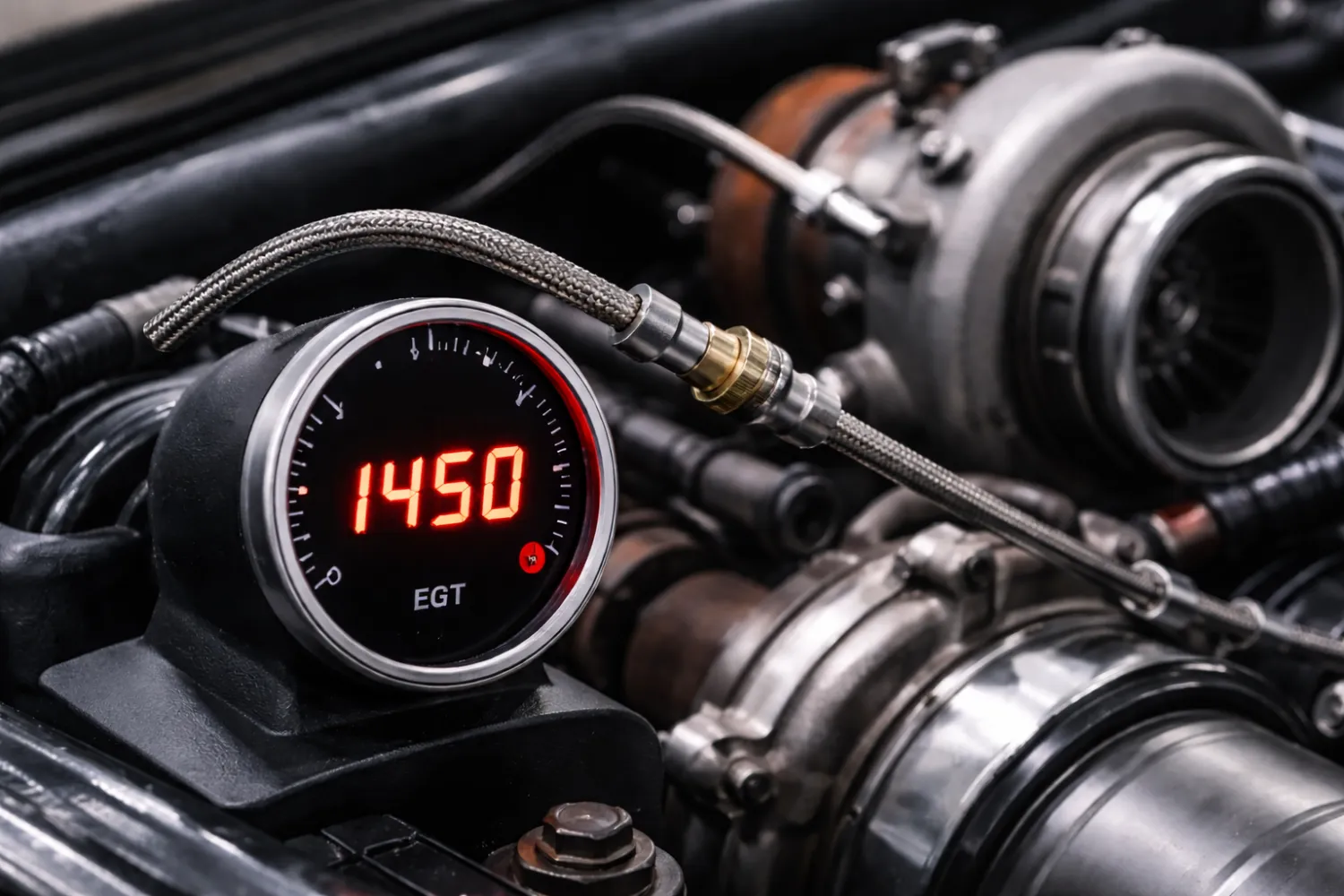
If you’re building power in a diesel engine, heat is always part of the equation. The question is whether you’re measuring it or ignoring it. That’s where a pyro kit earns its place. For tuned, deleted, towed, or off-road diesel vehicles, exhaust gas temperature is the one metric that tells you what’s really happening inside the engine. I’ve seen plenty of builds with big power numbers and shiny parts fail early for one simple reason. Nobody was watching EGT.
A pyro kit isn’t about adding horsepower. It’s about keeping the horsepower you already made from destroying expensive engine components. When fueling increases, temperatures rise. That’s physics, not opinion. And once exhaust gas temperature climbs beyond safe limits, damage doesn’t ask for permission.
At Explosive Diesels, we treat EGT monitoring as essential. Not optional. Essential.
Understanding Exhaust Gas Temperature (EGT)
Exhaust gas temperature measures the heat leaving the combustion chamber through the exhaust stream. That heat is a direct result of how much fuel is burned, how efficiently it burns, and how much load the engine is under. In diesel engines, EGT rises quickly under stress. Long hill climbs. Heavy towing. Aggressive throttle input. All of it shows up instantly in exhaust temperature.
According to Wikipedia’s technical overview of exhaust gas temperature, elevated EGT values are commonly caused by increased fueling, airflow restrictions, or excessive engine load, making EGT a reliable indicator of combustion stress and thermal efficiency.
Here’s what typical pre-turbo EGT ranges look like:
| Driving Condition | Typical EGT (Pre-Turbo) |
| Idle | 300–500°F |
| Highway cruise | 600–900°F |
| Moderate towing | 900–1,200°F |
| Heavy load | 1,200–1,500°F |
| Sustained danger zone | 1,600°F+ |
Brief spikes are one thing. Sustained high EGT is what causes real damage.
What Is a Pyro Kit?
A pyro kit is a dedicated exhaust gas temperature monitoring system. It measures real heat, not calculated values or estimates. The system relies on a thermocouple probe installed in the exhaust stream, most commonly before the turbocharger.
A typical pyro kit includes:
- Thermocouple probe (usually K-type)
- Wiring harness
- EGT gauge (analog or digital)
- Mounting hardware
That’s it. No gimmicks. No guesswork.
When exhaust temperature rises, the probe reacts immediately. The gauge shows you exactly what’s happening. No lag. No smoothing.
Pre-Turbo vs. Post-Turbo Pyro Placement
Placement matters more than most people realize.
Pre-Turbo Placement
- Installed in the exhaust manifold
- Measures true combustion temperature
- Fastest response time
- Most accurate data for engine safety
Post-Turbo Placement
- Installed after the turbocharger
- Reads cooler temperatures
- Slower response
- Requires temperature offset assumptions
| Feature | Pre-Turbo | Post-Turbo |
| Accuracy | Highest | Moderate |
| Response speed | Immediate | Slower |
| Reading values | Higher | ~200–300°F lower |
| Preferred for performance | Yes | Only if necessary |
For performance builds, pre-turbo placement is the standard. Always has been.
Why Tuned and Deleted Diesels Need a Pyro Kit
Tuning adds fuel. Deletes improve flow. Both increase EGT potential. That combination makes a pyro kit critical.
Without EGT monitoring:
- You won’t know when fueling exceeds airflow
- You won’t know when towing loads are too heavy
- You won’t know when to back out of the throttle
With a pyro kit:
- You react instantly
- You protect pistons and exhaust valves
- You manage turbo heat properly
The U.S. Department of Energy emphasizes that prolonged thermal stress reduces material strength and accelerates component fatigue in internal combustion engines, reinforcing the importance of active temperature management. Heat management isn’t optional once power increases.
Pyro Kits vs. Tuner-Displayed EGT
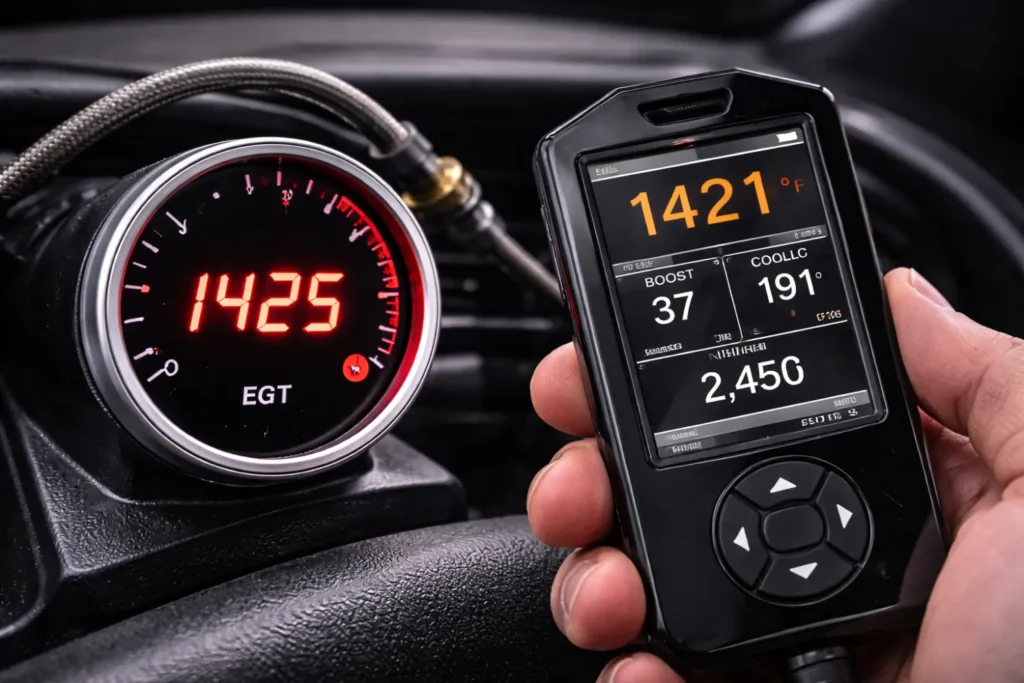
Many tuners display EGT. That doesn’t mean they’re measuring it directly. Some readings are estimated using ECU models. Others rely on limited sensors. A pyro kit uses a physical probe in the exhaust stream.
| Feature | Pyro Kit | Tuner Display |
| Measurement type | Direct | Often calculated |
| Accuracy | High | Varies |
| Reaction time | Instant | May lag |
| Reliability | Excellent | Tune-dependent |
Many serious diesel owners run both. The tuner for convenience. The pyro kit for truth.
Diesel Platforms That Benefit Most from Pyro Kits
Any turbocharged diesel benefits from EGT monitoring, but some platforms absolutely demand it.
- 5.9L & 6.7L Cummins
- 6.0L, 6.4L, 6.7L Power Stroke
- Duramax LB7 through L5P
- EcoDiesel platforms
- Off-road race trucks and UTVs
If it’s tuned, towed, or pushed hard, a pyro kit belongs on it.
How to Read Pyro Kit Data While Driving
A pyro kit becomes powerful when you use it actively.
Watch EGT behavior during:
- Acceleration
- Gear changes
- Hill climbs
- Heavy towing
Key driving adjustments:
- Lift slightly when EGT rises rapidly
- Downshift early under load
- Avoid lugging the engine
- Use trends, not single numbers
After a while, EGT awareness becomes second nature.
Installing a Pyro Kit: What to Know First
Installing a pyro kit isn’t difficult, but it requires care.
Common installation tools:
- Drill and tap set
- Cutting oil
- Grease or vacuum for shavings
- Safety glasses
Pre-turbo installs require drilling and tapping the exhaust manifold. Capturing metal shavings is critical. Grease on the drill bit works well when done slowly. Rushing this step causes expensive mistakes.
DIY vs. Professional Installation
Both approaches work.
DIY installation:
- Lower cost
- Requires confidence
- Best for experienced hands
Professional installation:
- Faster
- Cleaner
- Reduced risk
If drilling the manifold makes you uncomfortable, let a shop handle it.
Pyro Kit Accuracy and Maintenance
Quality pyro kits are extremely accurate.
Things to inspect periodically:
- Probe wiring near heat sources
- Secure probe mounting
- Stable gauge readings
Most probes last years under normal conditions. Erratic readings usually point to wiring or probe issues, not the gauge itself.
Choosing the Right Pyro Kit
Not all pyro kits are equal.
Look for:
- Clear, readable gauge
- Fast response time
- High-quality thermocouple
- Compatibility with existing gauge pods
Simple and reliable always wins.
Common Pyro Kit Myths
Let’s clear the air.
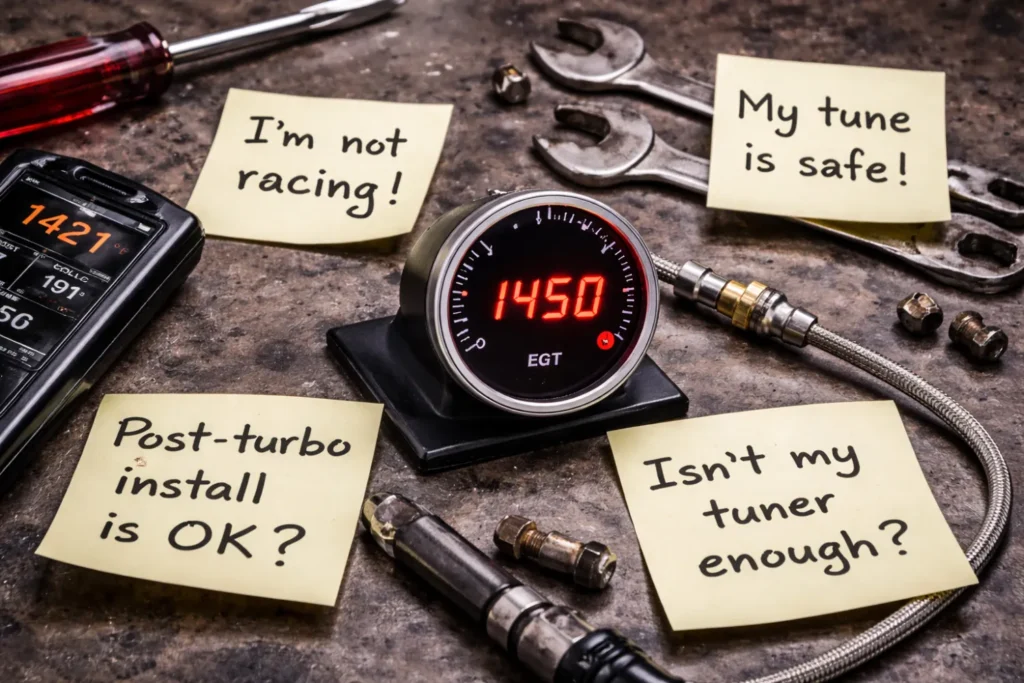
- “I don’t race, so I don’t need one.”
Towing and daily driving still generate dangerous heat. - “Post-turbo readings are fine.”
They work, but they hide true combustion temperature. - “My tune is safe.”
No tune overrides physics. - “I’ll feel engine damage before it happens.”
You won’t.
A pyro kit removes assumptions.
Long-Term Engine Reliability Benefits
High heat shortens engine life.
EGT monitoring helps:
- Protect piston crowns
- Preserve exhaust valves
- Extend turbocharger life
- Maintain consistent performance
Engines that last tend to stay cool.
Pyro Kits for Towing vs. Performance Driving
Towing:
- Sustained load
- Gradual heat buildup
- Requires discipline
Performance driving:
- Fast EGT spikes
- High fueling demand
- Requires quick reaction
Both benefit from a pyro kit. The behavior just looks different.
Legal Considerations for Off-Road Use
A pyro kit is a monitoring device. It does not modify emissions systems.
That said:
- Off-road builds may not be street legal
- Regulations vary by location
- Monitor responsibly
Measuring heat is never the problem. Ignoring it usually is.
Final Thoughts: Why Every Serious Diesel Build Needs a Pyro Kit
Power is fun. Heat is unavoidable. A pyro kit gives you awareness. Awareness gives you control. Control protects your engine. At Explosive Diesels, we believe smart performance lasts longer. If you’re pushing fuel, towing heavy, or running aggressive tunes, a pyro kit isn’t optional. It’s foundational. Cheap insurance. Real data. Smarter diesel performance.
FAQS
A pyro kit monitors exhaust gas temperature in real time, helping you prevent excessive heat that can damage pistons, valves, and turbochargers.
Yes, because tuning increases fueling and heat, and a pyro kit provides direct temperature feedback that tunes alone cannot fully account for.
Pre-turbo installation in the exhaust manifold is preferred because it delivers the most accurate and fastest EGT readings.
Sustained pre-turbo EGTs above roughly 1,600°F can cause internal engine damage and should be avoided.
Tuner-displayed EGT values are often calculated estimates, while a pyro kit measures actual exhaust temperature using a physical probe.
Stock trucks may not require one, but a pyro kit becomes highly recommended if you tow, tune, or regularly operate under heavy load.
Installation is straightforward for experienced DIYers, but drilling and tapping the exhaust manifold should be done carefully to avoid turbo damage.
Most quality probes last several years, though extreme heat, vibration, or wiring issues can shorten their lifespan.
A pyro kit does not add power directly, but it allows you to safely manage heat so you can use existing power without risking engine damage.
Yes, pyro kits are monitoring devices and do not modify emissions systems, though overall vehicle legality depends on other installed components.