
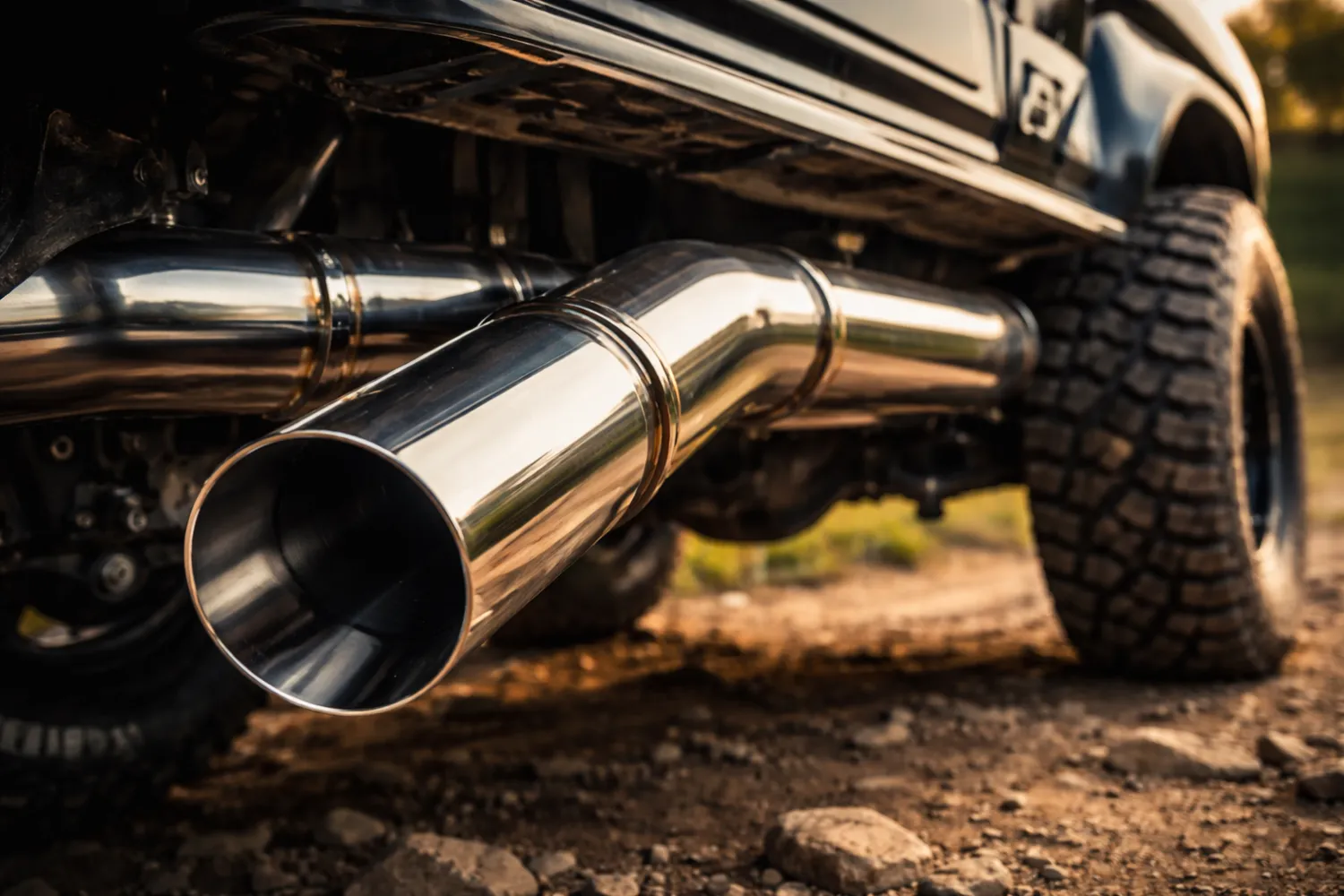
If you spend any real time pushing your truck off the pavement, exhaust material stops being a cosmetic decision and starts becoming a reliability one. Heat. Moisture. Vibration. Long pulls under load. This is where a T304 stainless steel exhaust separates itself from cheaper options. On paper, exhaust tubing looks simple. In the real world especially the off-road diesel world material choice determines how long your system lasts, how it sounds, and how well it supports performance upgrades.
At Explosive Diesels, we care about parts that survive abuse. Not just parts that look good in a catalog photo. And when it comes to exhaust systems, T304 stainless steel continues to earn its reputation as the gold standard for serious off-road performance.
Let’s break down why.
Why Exhaust Material Matters More Than Most People Admit
An exhaust system lives a hard life. It handles extreme heat cycles, constant vibration, moisture exposure, and impacts from trail debris. On a diesel truck, it also deals with sustained exhaust gas temperatures that would destroy low-grade steel over time.
Material choice affects:
- Longevity
- Heat resistance
- Corrosion resistance
- Sound quality
- Structural integrity under load
Choose poorly, and you’ll be replacing sections every few years. Choose right, and you install it once and forget about it. That’s why the T304 stainless steel exhaust has become the benchmark for high-quality off-road builds.
What Is T304 Stainless Steel?
T304 stainless steel is an austenitic stainless alloy made primarily from iron, chromium, and nickel. The exact chemistry matters less than what it does in real use.
In simple terms, T304 offers:
- High resistance to corrosion
- Excellent heat tolerance
- Strong structural stability
- Long service life
T304 belongs to the austenitic stainless steel family, which is known for its higher chromium and nickel content that creates a passive oxide layer on the metal’s surface. This layer is what dramatically slows corrosion and oxidation compared to mild steel or low-alloy stainless, a process explained in detail in Wikipedia’s overview of stainless steel metallurgy.
It’s also non-magnetic and highly weldable two characteristics that matter when fabricating or repairing exhaust systems for off-road use.
Why T304 Stainless Steel Works So Well for Exhaust Systems
Diesel exhaust environments are harsh. Very harsh. Especially once tuning, towing, or off-road driving enters the picture.
A T304 stainless steel exhaust thrives in these conditions for several reasons.
Heat Resistance That Actually Holds Up
Diesel engines don’t just produce brief spikes of heat. They generate sustained thermal loads, especially during towing, long highway pulls, or steep off-road climbs. Lower-grade steels can warp, thin, or crack after repeated heat cycles. T304 resists scaling and structural weakening even when temperatures stay elevated for long periods.
That stability is critical when:
- Towing heavy loads
- Climbing long grades
- Running performance-oriented setups (off-road use only)
Heat resistance equals reliability. Simple as that.
Corrosion Resistance You Can Count On
Moisture is unavoidable. Rain. Snow. Mud. River crossings. Condensation inside the pipe. Your exhaust sees it all. The chromium-rich oxide layer in T304 acts as a barrier against corrosion. While surface discoloration can occur, the underlying metal remains intact far longer than mild steel or T409 stainless. That’s the difference between cosmetic change and structural failure.
T304 vs T409 Stainless Steel: The Real Comparison

This is the comparison everyone asks about, so let’s clear it up without marketing fluff.
Material Differences at a Glance
| Feature | T304 Stainless Steel | T409 Stainless Steel |
| Corrosion Resistance | Excellent | Moderate |
| Nickel Content | High | Low |
| Rust Appearance | Minimal surface staining | Visible surface rust |
| Longevity | Very long | Moderate |
| Cost | Higher | Lower |
T409 is widely used in factory exhaust systems because it’s cost-effective and adequate for stock applications. However, it sacrifices corrosion resistance to keep prices down.
What This Means Off-Road
In dry climates with light use, T409 can be serviceable. But for trucks exposed to water, salt, mud, or long-term ownership, T304 stainless steel exhaust systems last significantly longer.
T409 tends to rust on the surface early. Over time, that corrosion progresses inward. T304 slows that process dramatically, preserving wall thickness and structural strength.
In short:
- T409 works
- T304 lasts
How a T304 Stainless Steel Exhaust Supports Performance
Let’s be clear exhaust material alone doesn’t magically add horsepower. But it supports everything that does.
A quality T304 stainless steel exhaust helps performance by maintaining consistent flow and durability over time.
Reduced Backpressure
Smooth mandrel bends and stable tubing diameters allow exhaust gases to exit efficiently. Reduced restriction helps:
- Turbochargers spool more consistently
- Exhaust gas temperatures remain more stable
- Performance stays predictable under load
Better Heat Management
Warped or internally corroded exhaust tubing disrupts flow. T304 maintains its shape, diameter, and wall thickness far longer, preventing hidden restrictions that steal performance.
Sound Characteristics: Why Material Changes the Tone
Exhaust sound isn’t just about mufflers. Material plays a bigger role than many people realize.
A T304 stainless steel exhaust typically produces:
- A cleaner, sharper exhaust note
- Less dull resonance over time
- Better sound consistency as the system ages
Mild steel exhausts often deepen and distort as corrosion builds internally. T304 holds its tone much longer, especially when paired with a properly designed muffler. Cold starts sound crisp. Throttle response sounds clean. No unwanted rasp.
Durability Where It Actually Counts: Off-Road Use
Off-road environments punish weak exhaust systems.
Consider what your system endures:
- Chassis flex on uneven terrain
- Constant vibration on washboard roads
- Rock and debris impacts
- Repeated heat cycling
T304’s strength and ductility allow it to absorb movement without cracking. Welds hold. Hangers stay intact. Tubing resists fatigue. This is why overland rigs and trail trucks consistently choose T304 stainless steel exhaust systems despite the higher upfront cost.
High-Heat Diesel Applications and Why T304 Excels
Diesel exhaust systems operate under sustained thermal loads, not just momentary spikes. That includes high exhaust gas temperatures during towing, hauling, and aggressive driving. The U.S. Environmental Protection Agency explains how exhaust gas temperatures and system durability play a critical role in overall vehicle performance and emissions control in its emissions standards reference guide.
While that guidance focuses on emissions compliance, the underlying principle applies to off-road builds as well. Materials exposed to sustained heat must retain strength and shape. T304 does exactly that. Lower-grade steels may survive initially, but they lose integrity over time. T304 maintains it.
Is a T304 Stainless Steel Exhaust Worth the Cost?
This comes down to how you use your truck.
When T304 Makes Sense
- Long-term vehicle ownership
- Frequent off-road use
- Wet, salty, or humid environments
- Towing or high-load driving
- Performance-focused builds
When It May Be Overkill
- Short-term ownership
- Light daily driving only
- Dry climates with minimal exposure
- Strict budget limits
From a cost-per-year perspective, T304 stainless steel exhaust systems often end up cheaper because replacement cycles are dramatically longer.
Installation Considerations That Matter

Even the best material can fail if installed poorly.
When installing a T304 stainless steel exhaust, pay attention to:
- Proper hanger alignment
- Clearance for heat expansion
- Quality clamps or welds
- Adequate spacing near drivetrain components
TIG welding is preferred for custom work. Bolt-on systems should include hardware designed specifically for stainless steel. Cheap clamps can undermine an otherwise excellent system.
Maintenance: What T304 Does and Doesn’t Need
T304 is low maintenance, not no maintenance.
Expect:
- Heat-related discoloration
- Occasional surface staining
- Minimal structural corrosion
You can polish it if appearance matters. You can ignore it if it doesn’t. Functionally, it keeps doing its job. After hard off-road use, inspect for dents, hanger issues, or impact damage. That’s smart ownership, regardless of material.
Common Myths About T304 Stainless Steel Exhausts
Let’s clear the air.
- “Stainless doesn’t rust.”
False. It resists corrosion; it isn’t immune. - “All stainless exhausts are the same.”
Material grade makes a huge difference. - “It’s only for race trucks.”
Longevity matters more than racing. - “It’s too brittle for off-road use.”
T304 is actually more forgiving than many lower-grade steels.
Good information builds better trucks.
Who Should Choose a T304 Stainless Steel Exhaust?
This material is ideal for:
- Off-road diesel enthusiasts
- Overland builds
- Towing and work trucks
- Performance-oriented setups
- Owners planning to keep their truck long-term
If your truck is part tool, part toy, and part investment, a T304 stainless steel exhaust fits that mindset.
Responsible Off-Road Performance
At Explosive Diesels, we emphasize responsible performance. Exhaust upgrades should support reliability first, not just volume. Proper routing, heat management, and component clearance matter just as much as material choice. Build smart. Build durable. Build once.
Final Thoughts: Why T304 Remains the Benchmark
There’s a reason premium exhaust manufacturers continue to use T304 stainless steel. It lasts. It holds up to heat. It resists corrosion. And it survives real-world abuse.
A T304 stainless steel exhaust isn’t about trends or flash. It’s about removing weak points from your build so you can focus on driving instead of repairs. Install it once. Drive it hard. And move on knowing your exhaust won’t be the limiting factor.
That’s the Explosive Diesels standard.
FAQs
A T304 stainless steel exhaust is made from an austenitic stainless alloy with high chromium and nickel content, offering superior heat and corrosion resistance for demanding diesel applications.
T304 resists corrosion and heat damage far better than mild steel, making it more durable and reliable for long-term and off-road use.
T304 offers significantly better corrosion resistance and longer lifespan than T409, especially in wet, salty, or off-road environments.
On its own, it doesn’t add horsepower, but it supports performance upgrades by maintaining consistent exhaust flow and resisting internal degradation.
T304 can develop surface discoloration or staining, but it resists structural corrosion far better than lower-grade steels.
For long-term ownership, frequent off-road use, or harsh environments, the added durability often makes it more cost-effective over time.
Yes, T304 tends to produce a cleaner, sharper exhaust tone that stays more consistent as the system ages.
Absolutely, it handles sustained exhaust gas temperatures better than mild steel or lower-grade stainless alloys.
No special maintenance is required beyond occasional inspections; normal heat discoloration is expected and harmless.
Off-road diesel owners, overland builders, and anyone planning to keep their truck long-term will benefit most from T304.