
If you own a 2021 Jeep Gladiator EcoDiesel, chances are you didn’t buy it to behave politely on pavement. You bought it for torque. For trail days that stretch longer than planned. For towing gear into places gas trucks struggle to reach. That’s why more and more owners eventually find themselves researching a 2021 Jeep Gladiator EcoDiesel delete kit after living with the truck for a while.
I’ve watched the pattern repeat itself. The platform is capable. The engine is strong. But emissions equipment changes how the truck behaves once you leave ideal driving conditions behind. Regenerations interrupt trips. Throttle response feels dulled. Limp modes show up at the worst possible times. Suddenly, the confidence you expect from a diesel-powered Gladiator starts to fade. This article exists to explain why that happens and what a delete kit actually changes. No hype. No fear-driven messaging. Just practical, off-road-focused information so you can decide whether a 2021 Jeep Gladiator EcoDiesel delete kit fits your build and how to approach it responsibly.
The 3.0L EcoDiesel: Strong Foundation, Heavy Constraints
The 3.0L EcoDiesel used in the 2021 Gladiator is fundamentally well engineered. It delivers strong low-end torque, maintains efficiency under load, and pairs nicely with the Gladiator’s chassis for towing and crawling. On paper, it checks the right boxes.
The challenge isn’t the engine itself.
It’s what surrounds it.
From the factory, the EcoDiesel is calibrated to prioritize emissions compliance over consistency. That means added heat, increased exhaust restriction, and constant system monitoring. On-road, that tradeoff is manageable. Off-road, it becomes obvious very quickly. When airflow, exhaust temperature, and engine load stop behaving predictably, the emissions systems step in. And they don’t ask permission.
Emissions Systems That Limit the EcoDiesel Off-Road
Understanding why owners turn to a 2021 Jeep Gladiator EcoDiesel delete kit starts with understanding what the factory systems are designed to do and where they struggle.
Diesel Particulate Filter (DPF)
The DPF captures soot particles in the exhaust and burns them off during regeneration cycles. That process requires sustained exhaust temperatures and steady driving conditions.
Off-road use rarely provides either.
Low speeds, frequent stops, and short driving cycles prevent complete regeneration. According to the technical overview of diesel particulate filters on Wikipedia, regeneration depends on exhaust heat that is often absent during low-load operation, which leads to soot accumulation and rising backpressure. When the system can’t recover, the truck compensates with forced regens or power reduction.
That’s why DPF issues show up so frequently in trail-driven EcoDiesels.
Exhaust Gas Recirculation (EGR)
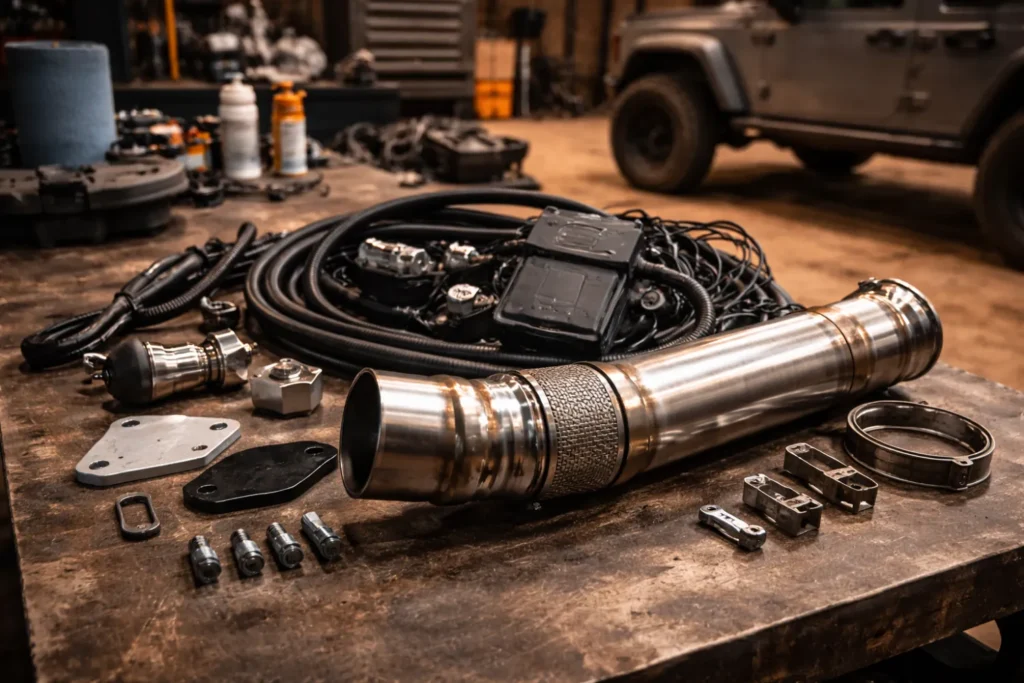
The EGR system reduces combustion temperatures by feeding exhaust gas back into the intake. Over time, soot and oil vapor coat intake components, restricting airflow and increasing heat where you don’t want it.
It’s not catastrophic overnight.
It’s cumulative.
DEF / SCR System
The SCR system injects diesel exhaust fluid to reduce NOx emissions. It relies on sensors, heaters, and dosing modules working in harmony. Trail vibration, cold weather, and contaminated DEF all increase failure risk.
When something goes wrong, the truck responds immediately. Often with limp mode.
What a 2021 Jeep Gladiator EcoDiesel Delete Kit Changes
A 2021 Jeep Gladiator EcoDiesel delete kit removes or bypasses the emissions components that restrict airflow and introduce failure points. Just as importantly, it recalibrates the ECU so the engine operates correctly without them.
A complete setup typically addresses:
- DPF removal
- EGR disablement or removal
- SCR/DEF system deactivation
- ECU tuning to manage fueling, boost, and torque
The engine isn’t pushed beyond its limits.
It’s simply freed from emissions-driven constraints.
Performance Gains That Matter Off-Road
Deleting doesn’t turn the Gladiator into something it isn’t. It turns it into something more predictable.
Power Delivery
Most owners notice improvements immediately:
- Stronger low-RPM torque
- Faster throttle response
- Smoother power application on climbs
Crawling becomes easier. Towing feels less strained. The engine responds when you ask it to, not when the emissions system allows it.
Exhaust Flow and Heat Reduction
Removing the DPF significantly reduces exhaust backpressure. Lower backpressure means lower exhaust gas temperatures and less stress on the turbocharger.
Heat management improves across the board.
Reliability: The Real Motivation
Horsepower sells delete kits.
Reliability justifies them.
With a 2021 Jeep Gladiator EcoDiesel delete kit, owners eliminate:
- Forced regeneration cycles
- Soot contamination in the intake
- DEF-related sensor failures
- Random power derates
Fewer systems mean fewer surprises.
For off-road rigs, that matters more than peak numbers ever will.
Fuel Economy: A Secondary Benefit
Fuel economy often improves, but expectations should stay realistic.
Why MPG Can Increase
- No fuel burned during regen cycles
- Improved combustion efficiency
- Reduced exhaust restriction
What Influences Results
- Tire size and gearing
- Driving habits
- Tune calibration
Highway mileage often sees the biggest gains. Trail use benefits more from consistency than raw MPG.
Why Proper Tuning Is Non-Negotiable
This cannot be overstated.
A 2021 Jeep Gladiator EcoDiesel delete kit lives or dies by its tune.
Proper calibration ensures:
- Safe air-fuel ratios
- Controlled turbo behavior
- Clean removal of emissions logic
- Transmission torque management
Poor tuning causes issues.
Good tuning prevents them.
This is where experience matters most.
Supporting Mods That Complement a Delete
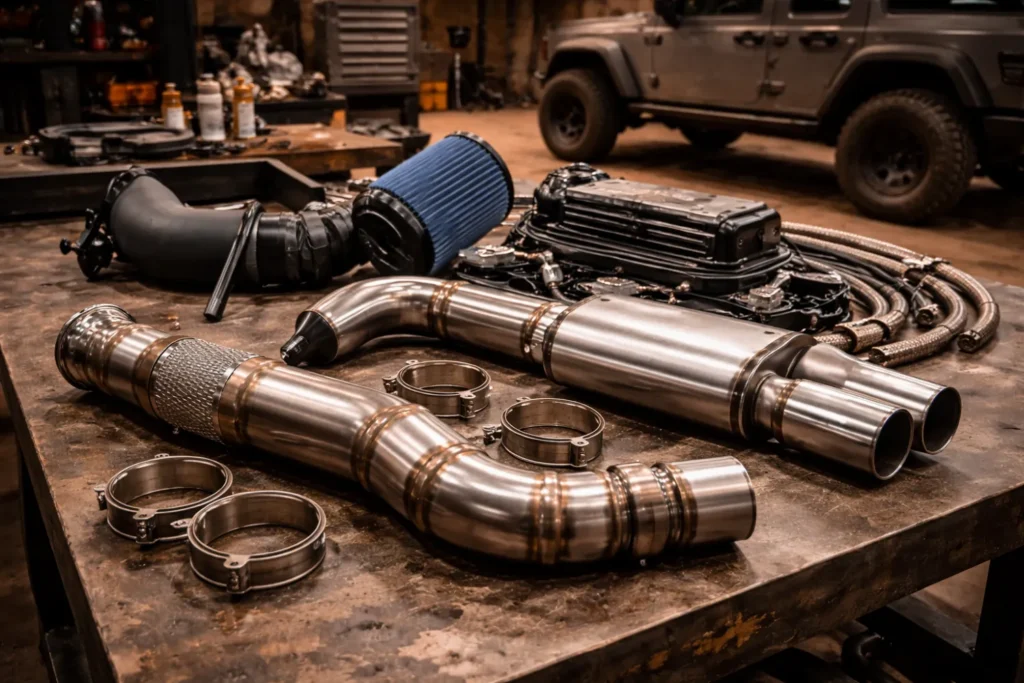
Deleting works best as part of a balanced setup.
Exhaust Systems
A straight-through exhaust improves heat evacuation and airflow. Proper diameter keeps noise reasonable and performance stable.
Intake Considerations
With EGR gone, intake cleanliness improves dramatically. An upgraded intake helps airflow but isn’t mandatory for reliability.
Drivetrain Awareness
Added torque is beneficial, but restraint matters. Aggressive tuning without regard for the transmission shortens component life.
Installation: What Owners Should Expect
Installation isn’t complicated, but it demands attention.
Typical Timeline
| Task | Estimated Time |
| Emissions removal | 4–6 hours |
| Exhaust install | 2–3 hours |
| ECU tuning | 30–60 minutes |
DIY installs save money. Professional installs save time and frustration.
Cost Breakdown: Realistic Numbers
A typical investment looks like this:
| Component | Estimated Cost |
| Delete hardware | $1,200–$2,000 |
| Tuning | $800–$1,500 |
| Exhaust | $400–$900 |
| Labor (optional) | $800–$1,500 |
Cutting corners here usually costs more later.
Legal and Off-Road Use Considerations
This matters, and it deserves clarity.
In the United States, emissions equipment is regulated under the Clean Air Act and enforced by the Environmental Protection Agency. The EPA clearly states that emissions control devices installed by manufacturers are required for on-road vehicles and may not be legally removed for highway use. Modifications such as a 2021 Jeep Gladiator EcoDiesel delete kit are permitted only for vehicles used exclusively in off-road or competition environments. Responsible ownership starts with understanding the law.
Who a Delete Kit Makes Sense For
Good Candidates
- Off-road–only Gladiators
- Overland builds used outside testing zones
- Tow rigs on private land
- Owners prioritizing long-term reliability
Who Should Think Twice
- Daily drivers in strict emissions states
- Warranty-dependent owners
- Short-term ownership plans
Honest assessment prevents regret.
Living With a Deleted EcoDiesel Long-Term
Deleting doesn’t eliminate maintenance.
It simplifies it.
Best Practices
- Regular oil changes
- Monitor exhaust temps
- Use quality fuel
- Drive with mechanical sympathy
Do that, and the EcoDiesel rewards you.
Clearing Up Common Myths
- Deletes ruin engines — poor tuning does.
- More power always reduces reliability — abuse does.
- Stock is safest — until emissions systems fail.
Context is everything.
Final Thoughts
For the right owner, a 2021 Jeep Gladiator EcoDiesel delete kit is less about power and more about control. Control over how the engine behaves. Control over reliability. Control over how the truck performs when conditions aren’t ideal.That’s what matters off-road.
And that’s what Explosive Diesels is built around.
FAQs
A 2021 Jeep Gladiator EcoDiesel delete kit removes factory emissions components like the DPF, EGR, and DEF systems for off-road use, paired with proper ECU tuning.
Most owners delete to improve reliability, eliminate regeneration issues, and restore consistent power delivery during off-road and towing use.
Yes, moderate power gains are common, but the biggest improvement is smoother torque delivery rather than peak horsepower numbers.
Yes, tuning is mandatory to safely recalibrate fueling, boost, and emissions logic once the factory components are removed.
Many owners see slight fuel economy gains due to the removal of regeneration cycles and reduced exhaust restriction, though results vary.
A deleted EcoDiesel is intended for off-road or competition use only and may not be legal for street driving depending on local regulations.
When paired with proper tuning and maintenance, deleting often reduces heat, soot buildup, and emissions-related failures that affect long-term reliability.
Installation is manageable for experienced DIYers but requires time, proper tools, and attention to detail; many owners choose professional installation.
Yes, removing emissions components can affect warranty coverage related to the engine, exhaust, and powertrain.
For off-road-focused owners prioritizing reliability and consistent performance, a delete kit can significantly improve the ownership experience.