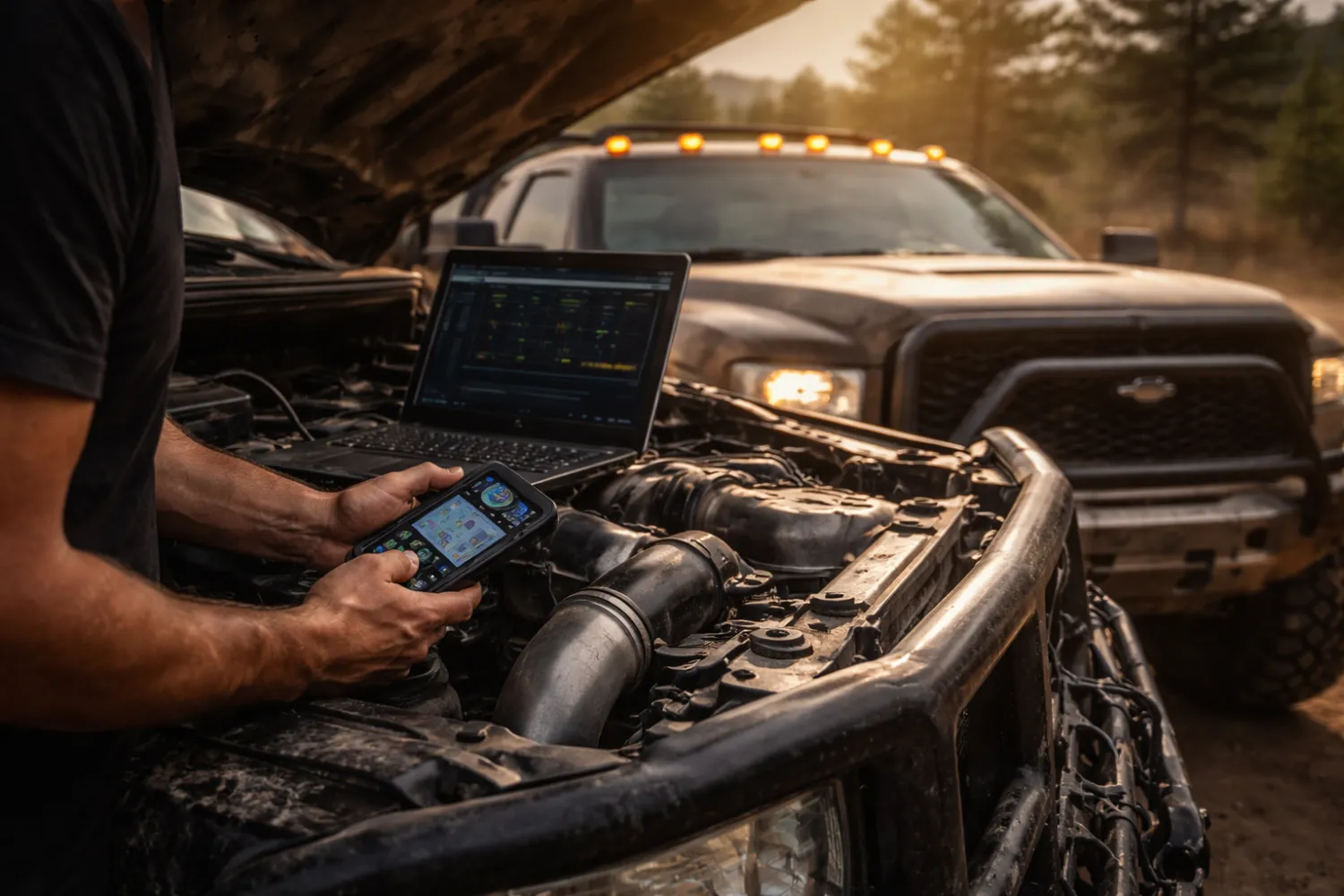
Modern diesel trucks are impressive machines. They’re refined, powerful, and loaded with technology. Yet anyone who actually uses their truck off-road or under sustained load knows the truth almost immediately factory emissions systems hold these engines back. That’s exactly why the diesel delete tuner has become one of the most impactful upgrades in the off-road diesel world.
At Explosive Diesels, we focus on real performance. Not brochure numbers. Not marketing hype. Real-world gains you can feel behind the wheel. A properly calibrated diesel delete tuner doesn’t just add power. It restores control, predictability, and reliability to engines that were never designed to live their entire lives under emissions restrictions.
Let’s walk through what delete tuning really does, why it works, and how to use it correctly.
What Is a Diesel Delete Tuner?
A diesel delete tuner is specialized engine calibration software designed to operate a diesel engine without factory emissions components such as the EGR, DPF, and SCR/DEF systems. Once those systems are removed for off-road use, the factory ECU logic no longer makes sense. That’s where tuning becomes mandatory.
This isn’t about “turning things off.”
It’s about rebuilding the operating strategy of the engine.
A quality diesel delete tuner recalibrates fuel delivery, injection timing, boost pressure, and transmission behavior so the engine runs cleanly, efficiently, and consistently without emissions interference. Without proper tuning, deleted trucks run poorly. With it, they finally operate the way diesel engines were always capable of running.
Why Emissions Systems Restrict Diesel Performance
Diesel emissions systems were engineered to meet regulatory targets, not to support off-road durability or heavy-load performance. According to the U.S. Environmental Protection Agency, emissions controls on heavy-duty diesel engines are designed to reduce nitrogen oxides and particulate matter in on-road applications, even when those systems introduce added heat, complexity, and operational constraints during normal use. The EPA outlines these control strategies clearly in its documentation on heavy-duty diesel engines, which helps explain why factory calibrations often prioritize compliance over drivability and long-term reliability in demanding conditions.
EGR: Hot Exhaust Where It Doesn’t Belong

The Exhaust Gas Recirculation system reroutes exhaust back into the intake stream. That reduces emissions. It also raises intake temperatures and introduces soot into the engine.
Over time, this leads to:
- Carbon buildup
- Reduced throttle response
- Higher combustion temperatures
DPF: Regen Events and Power Loss
The Diesel Particulate Filter traps soot and periodically burns it off during regeneration cycles. These events spike exhaust gas temperatures and disrupt normal power delivery.
Anyone who’s felt random power drops or inconsistent throttle response has experienced regen side effects.
DEF/SCR: Sensors and Limp Modes
DEF systems rely on heaters, injectors, and sensors that do not love vibration, dust, or harsh operating environments. One failed sensor can force reduced power or limp mode at the worst possible moment.
How a Diesel Delete Tuner Actually Works
Once emissions systems are removed, the ECU must be reprogrammed to operate under entirely different conditions. A diesel delete tuner restructures how combustion happens.
Key tuning changes include:
- Fuel mapping optimized for airflow, not emissions cycles
- Injection timing calibrated for usable torque
- Boost control that reduces lag and stabilizes pressure
- Transmission tuning that matches new torque output
This isn’t guesswork. Diesel engine tuning relies on well-established principles of combustion, injection timing, and air management. A detailed technical overview of diesel engine operation including how fuel injection timing and turbocharging affect performance can be found in Wikipedia’s comprehensive diesel engine reference, which helps illustrate why recalibrating these parameters after emissions removal is essential for stable operation.
When tuning is done correctly, the engine behaves predictably. Power arrives smoothly. Heat stays controlled. Driveability improves across the board.
Performance Gains You Can Expect
Let’s set realistic expectations.
A diesel delete tuner doesn’t create power out of thin air. It unlocks power that emissions controls suppress.
Horsepower and Torque
Typical gains for off-road builds fall into these ranges:
- 60–120 horsepower
- 120–250 lb-ft of torque
The real benefit is torque delivery. Power comes on sooner and stays consistent under load.
Throttle Response
This is the most noticeable change.
Turbo lag drops. Acceleration feels linear. The truck responds immediately instead of waiting for emissions logic to catch up.
Fuel Economy
Contrary to popular belief, fuel economy often improves. With no regen cycles and optimized fueling, steady-state efficiency increases for many off-road setups.
Diesel Delete Tuner vs Emissions-Compliant Tuning
Emissions-on tuners operate within strict boundaries:
- Conservative fueling
- Restricted boost
- Limited thermal headroom
A diesel delete tuner removes those constraints and allows the engine to be tuned for how it’s actually used.
| Feature | Emissions-On Tuner | Diesel Delete Tuner |
| Power Potential | Limited | Significantly higher |
| Throttle Response | Moderate | Sharp and consistent |
| Regen Interference | Yes | None |
| Off-Road Reliability | Average | Improved |
| Customization | Restricted | Extensive |
For off-road builds, the difference is not subtle.
Common Diesel Delete Tuner Platforms
Handheld Tuners
Simple and effective.
- Plug-and-play
- Multiple power levels
- Ideal for mild builds
Custom PC-Based Tuning
The choice for serious performance.
- Tailored fuel and boost maps
- Injector and turbo-specific tuning
- Best for stacked modifications
Switch-On-The-Fly Systems
Perfect for changing terrain.
- Tow mode
- Trail mode
- Performance mode
Engine-Specific Delete Tuning Considerations
6.7 Cummins
Delete tuning reduces soot buildup, stabilizes EGTs, and improves transmission behavior under load.
6.7 Powerstroke
Benefits include better turbo response, smoother power delivery, and improved exhaust flow when paired with proper tuning.
Duramax Platforms
Precision matters. Proper fueling control and transmission tuning are essential for long-term reliability.
EcoDiesel
Moderate tuning works best. Gains focus on drivability and throttle response rather than peak numbers.
Supporting Mods That Maximize Results
A diesel delete tuner performs best when supported by smart upgrades:
- High-flow exhaust
- Upgraded intercooler
- Cold air intake
- Lift pump for fuel stability
- Transmission tuning or upgrades
You don’t need everything at once, but airflow and fueling support unlock the tuner’s full potential.
Reliability After Delete Tuning
This surprises many people.
When tuned correctly, delete setups often improve reliability:
- Lower exhaust gas temperatures
- Reduced soot circulation
- Fewer failure-prone components
- Cleaner oil over time
Bad tuning causes problems. Good tuning prevents them.
Common Myths That Need to Go
- “Delete tuners ruin engines.” Poor tuning does. Proper tuning doesn’t.
- “Fuel economy always drops.” Many builds see gains.
- “Transmissions can’t handle it.” Untuned transmissions can’t. Tuned ones often can.
The difference is execution.
Legal and Off-Road Use Disclaimer

Diesel delete tuners are intended for off-road use only including competition vehicles, private land use, and track applications. Understanding and respecting that distinction is part of responsible ownership.
Is a Diesel Delete Tuner Right for You?
If your truck sees:
- Off-road use
- Heavy towing
- Long idle times
- Performance-focused driving
Then delete tuning may align with your goals.
Choosing the Right Diesel Delete Tuner
Focus on:
- Platform compatibility
- Proven tuning quality
- Update and support availability
- Long-term reliability, not peak numbers
At Explosive Diesels, we’ve seen firsthand how proper tuning transforms trucks—not into monsters, but into controlled, capable machines.
Final Thoughts: Control Is the Real Upgrade
A diesel delete tuner isn’t about noise or shock value.
It’s about control.
When emissions logic stops dictating engine behavior, tuning can finally optimize performance for real-world use. Power becomes predictable. Heat becomes manageable. Driveability improves everywhere.
That’s what real diesel performance looks like.
And that’s what we build for at Explosive Diesels.
FAQs
A diesel delete tuner is engine calibration software that allows a diesel engine to run properly after emissions systems are removed for off-road use.
Yes, tuning is required to recalibrate fuel, timing, and boost so the engine operates correctly without emissions systems.
Most off-road builds gain between 60–120 horsepower and 120–250 lb-ft of torque, depending on the platform and tune quality.
Yes, delete tuning significantly reduces turbo lag and creates smoother, more immediate throttle response.
Fuel economy often improves during steady driving because regeneration cycles are eliminated and fueling is optimized.
When done correctly, delete tuning can improve reliability by lowering exhaust temperatures and reducing soot buildup.
Yes, proper tuning adjusts shift points and torque management to protect the transmission under increased power.
No, diesel delete tuners are intended for off-road use only, such as competition, track, or private land applications.
High-flow exhausts, upgraded intercoolers, lift pumps, and transmission tuning help maximize performance and reliability.
Choose a tuner that matches your engine platform, offers proven tuning quality, and provides reliable updates and support.